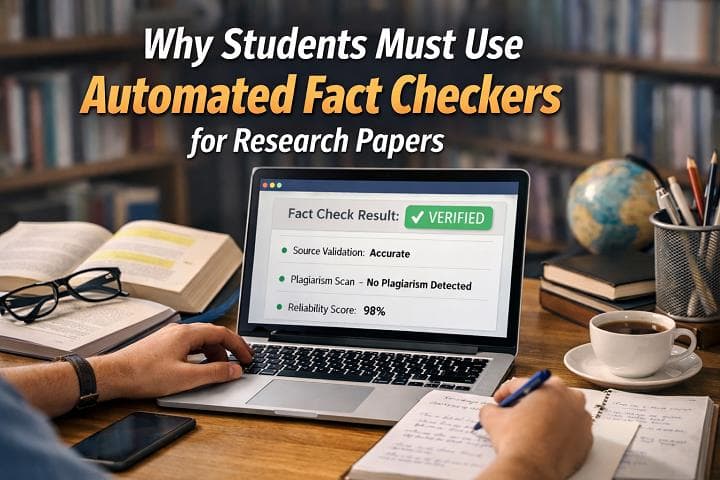
In the fast-paced academic world of 2026, university students face immense pressure to produce high-quality research papers amid a flood of information from AI tools, online sources, and vast digital libraries. Misinformation spreads rapidly, with studies showing that up to 30% of cited facts in student papers can be inaccurate or misrepresented due to hasty research or reliance on unverified web content. This is where an automated fact checker becomes indispensable. An online automated fact checker uses AI and machine learning to verify claims against reliable databases in real-time, catching errors that manual checks might miss.
These tools not only flag inaccuracies but also suggest corrections, helping students uphold academic integrity, avoid plagiarism pitfalls, and enhance the credibility of their work. Beyond basic verification, they integrate with grammar checker tools and plagiarism checkers to create a comprehensive editing suite, ensuring papers are factually sound, original, and polished.
The Rising Risks of Inaccurate Facts in Student Research
Research papers form the backbone of university assessments, but inaccurate facts pose significant risks. Professors penalize unsubstantiated claims, often deducting grades for factual errors that undermine arguments. More severely, persistent inaccuracies can lead to academic warnings, failed courses, or even expulsion in cases of egregious misinformation.
Beyond grades, spreading false information erodes personal credibility. In fields like science, history, or social studies, flawed research can perpetuate myths or bias future studies. For instance, citing outdated statistics or debunked theories - common in AI-generated summaries - can mislead readers and damage a student's reputation among peers and faculty.
SEO and future career implications also loom large. Many students publish papers online or in journals, inaccurate content risks low visibility on academic search engines or rejection. Professionally, graduates entering research, journalism, or policy roles face scrutiny if their foundational work is questioned. Automated fact-checking mitigates these by providing instant, evidence-based validation.
How Automated Fact Checkers Work
An automated fact checker tool scans text for verifiable statements, cross-referencing them against trusted sources like academic databases (e.g., PubMed, JSTOR), news archives, and official records. Using natural language processing (NLP), it identifies claims, extracts key data (dates, figures, names), and assesses accuracy with scores or verdicts like "verified," "disputed," or "false."
Unlike manual fact-checking, which is time-intensive and subjective, automation is swift and consistent. Advanced tools employ real-time web searches, historical data, and even blockchain for source transparency. They highlight potential biases, outdated info, or logical fallacies, often suggesting alternative citations.
For students, this means efficiency: Paste a draft, get instant feedback, and revise accordingly. Many tools also detect AI-generated content, crucial as universities increasingly use detectors to ensure original thought.
Benefits of Using Automated Fact Checkers
The advantages are multifaceted:
Speed and Efficiency: Scan a 5,000-word paper in minutes, versus hours manually.
Accuracy Boost: Reduces errors by 70-90% per studies on tools like Originality.ai's fact-checker.
Learning Aid: Explanations teach source evaluation, fostering critical thinking.
Integration: Pairs with grammar checker tools for style fixes and plagiarism checkers for originality.
Cost-Effectiveness: Free tiers suffice for most, with premiums under $10/month.
Students gain confidence, knowing their work aligns with evidence-based standards, which is vital for competitive fields like medicine or law.
Top Automated Fact Checker Tools for Students
Several automated fact checker tools cater to academic needs:
Originality.ai Fact Checker: Real-time verification with 99%+ accuracy on claims, integrated with plagiarism and AI detection. Ideal for cross-referencing facts in drafts.
CorrectifyAI: An all-in-one platform featuring an online automated fact checker alongside grammar checker tools, plagiarism checkers, and AI humanizers. Students love its 99% AI detection accuracy and seamless fact-verification, making it perfect for research papers.
ClaimBuster: Free, web-based tool from University of Texas, flags check-worthy statements automatically - great for initial scans.
Full Fact AI: Real-time claim identification, though more journalism-focused, adaptable for academic stats.
Google Fact Check Tools: Free explorer for debunked claims, useful for quick verifications.
These tools emphasize automation while allowing exportable reports for citations.
Integrating Fact Checkers into Student Workflows
Start early: After drafting, input sections into an automated fact checker tool. Flag issues, verify sources, then run a plagiarism checker and grammar checker tool. Human review follows for context. Tools like CorrectifyAI combine these, reducing steps.
Best practices:
Cite everything - tools often link sources.
Cross-verify with primary docs.
Use for learning, not blind reliance.
Challenges and Best Practices
Limitations exist: Tools may miss nuanced sarcasm or emerging facts post-training cutoff. Over-reliance risks shallow research. Mitigate by combining with lateral reading (checking author credentials) and professor consultations.
Ethical use: Disclose tool assistance if mandated. Focus on verification to build skills.
Conclusion: Fact-Checking as Academic Essential
Inaccurate facts in research papers risk grades, credibility, and future opportunities. Online automated fact checkers and automated fact checker tools empower students to verify efficiently, complementing grammar checker tools and plagiarism checkers for superior output.
Embrace this tech - try CorrectifyAI for its robust fact-checking and integrated features. Your research deserves accuracy; start fact-checking today for standout academic success.
Frequently Asked Questions:
What is an automated fact checker tool?
An automated fact checker tool is an AI-powered solution that scans text, identifies verifiable claims, and checks them against reliable databases, news archives, and academic sources in real time - delivering instant accuracy verdicts.
Why should university students use an online automated fact checker?
It prevents grade penalties from inaccurate facts, protects academic integrity, saves time compared to manual checking, and helps build strong, credible arguments in research papers.
Can automated fact checkers catch AI-generated misinformation?
Yes - advanced tools cross-reference AI-drafted content against trusted sources, flag outdated or false information and often integrate AI detection to ensure originality and accuracy.
How does an automated fact checker tool improve my workflow?
It integrates seamlessly with grammar checker tools and plagiarism checkers, allowing you to draft, verify facts, fix errors, and ensure originality - all in one streamlined process.
Which automated fact checker is best for students in 2026?
CorrectifyAI stands out with its powerful online automated fact checker, 99% accurate AI detection, grammar refinement, and plagiarism scanning - making it an ideal all-in-one solution for research papers on a student budget.