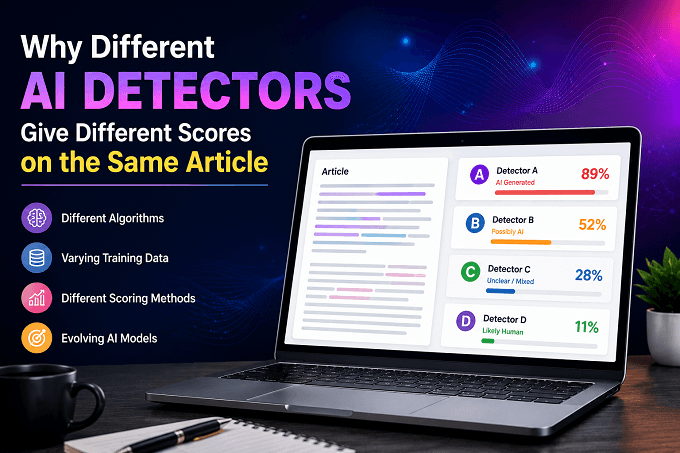
Artificial intelligence has transformed the way content is created, edited, and published. With the widespread adoption of AI writing tools, businesses, educators, publishers, and marketers increasingly rely on AI detector tools to determine whether content has been generated by artificial intelligence. However, many users encounter a common issue: the same article can receive significantly different scores when tested across multiple AI detection platforms.
One detector may identify content as 90% AI-generated, while another may classify the same text as mostly human-written. This inconsistency often leads to confusion and raises questions about the reliability of AI detection technology.
In this article, we'll explore why different AI detectors give different scores on the same article and what users should know when evaluating AI-generated content.
Understanding How AI Detector Tools Work
Before examining the reasons for score differences, it's important to understand how AI detector tools operate.
Most AI content detectors analyze writing patterns rather than checking a database of known AI-generated text. They use machine learning models and statistical analysis to evaluate characteristics commonly found in AI-written content, such as:
Sentence structure consistency
Predictable word choices
Repetitive phrasing
Content flow patterns
Perplexity scores
Burstiness measurements
These indicators help determine the likelihood that content was generated by an AI writing model. However, each AI detection platform uses its own algorithms, datasets, and scoring methods, which can produce varying results.
Different Detection Models Produce Different Results
One of the primary reasons AI detection scores vary is that each platform is built using a unique detection model.
Just as AI writing systems are trained on different datasets, AI content detection tools are trained using different collections of human-written and AI-generated content. The data used during training influences how effectively a detector identifies specific writing patterns.
Some detectors are optimized for identifying content created by large language models, while others focus on detecting heavily edited AI content. As a result, the same article may trigger different confidence levels depending on which model is evaluating it.
Variations in Scoring Methodologies
Not all AI detector tools measure content in the same way.
Some platforms provide a percentage score indicating the probability that content was generated by AI. Others classify content into categories such as:
Human-written
Mostly human
Mixed content
AI-assisted
AI-generated
Because scoring systems differ, comparing results across multiple detectors can be challenging.
For example, one detector may consider a 60% probability as "likely AI," while another may classify the same probability as "uncertain." This difference alone can create dramatically different outcomes for the same article.
AI Models Continue to Evolve
The rapid advancement of AI writing technology also contributes to inconsistent detection scores.
Modern AI writing tools produce content that is significantly more sophisticated than earlier models. Advanced systems can mimic human writing styles, incorporate natural variations, and generate highly readable content.
Some AI detectors update their algorithms regularly to keep pace with evolving AI models, while others may lag behind. As a result, newer AI-generated content may be easier for some detectors to identify and more difficult for others.
This ongoing race between AI generation and AI detection technology is one of the biggest challenges facing the industry today.
Human Editing Changes Detection Results
Another major factor is human intervention.
Many content creators do not publish raw AI-generated text. Instead, they edit, rewrite, and personalize the content before publication.
Human modifications may include:
Rewriting sentences
Adding personal insights
Changing paragraph structure
Adjusting tone and style
Including original research
These edits can significantly alter the writing patterns that AI detectors analyze.
An article that initially appears highly AI-generated may receive much lower AI detection scores after extensive human editing. Different detectors react differently to these changes, leading to inconsistent results.
Organizations using platforms like CorrectifyAI often evaluate content authenticity by considering both AI indicators and the extent of human contribution rather than relying solely on a single score.
False Positives Remain a Challenge
False positives occur when human-written content is incorrectly flagged as AI-generated.
This issue is particularly common in content that follows structured writing formats, including:
Academic papers
Technical documentation
Business reports
Legal content
Instructional guides
Because these types of content often use clear and predictable language, some AI detector tools may interpret them as AI-generated.
As a result, genuinely human-written content can receive elevated AI scores even when no artificial intelligence was used during creation.
False positives remain one of the most debated topics in the AI detection industry.
Language and Writing Style Influence Scores
Writing style also affects AI detection outcomes.
Certain characteristics may increase the likelihood of being flagged by AI detectors:
Short repetitive sentences
Highly formal language
Consistent sentence lengths
Generic transitions
Lack of personal perspective
Conversely, content that includes storytelling, unique opinions, personal experiences, and varied sentence structures often appears more human to detection systems.
Because each AI detector tool weighs these factors differently, the same article may produce varying results across platforms.
No AI Detector Is 100% Accurate
Perhaps the most important point to understand is that no AI detection tool can guarantee perfect accuracy.
AI detectors generate probability-based assessments rather than definitive conclusions. They estimate the likelihood that content was produced using artificial intelligence based on observable patterns.
Factors affecting accuracy include:
Content length
Writing style
Level of human editing
AI model used
Detector training data
Algorithm updates
For this reason, experts generally recommend using multiple AI detection tools when evaluating content authenticity rather than relying on a single platform.
Best Practices When Using AI Detectors
To obtain more reliable results, consider the following best practices:
Test Content Across Multiple Platforms
Comparing results from different AI detector tools can provide a broader perspective.
Focus on Patterns Instead of Scores
Rather than concentrating solely on percentages, review the overall assessment and highlighted sections.
Consider Human Editing
Remember that edited AI-generated content may appear significantly different from raw AI output.
Use Detection as Guidance
AI detection should support content evaluation rather than serve as the sole decision-making factor.
Stay Updated
As AI writing technology evolves, detection methods continue to improve. Regularly reviewing updated tools and methodologies is essential.
Conclusion
Different AI detectors give different scores because they rely on unique algorithms, training datasets, scoring systems, and detection methodologies. Human editing, writing style, false positives, and the continuous evolution of AI writing models further contribute to score variations.
Rather than treating AI detection results as absolute truth, users should view them as informed estimates based on statistical analysis. By understanding how AI detector tools work and why discrepancies occur, content creators, educators, publishers, and businesses can make more informed decisions about content authenticity. As AI technology continues to advance, solutions like CorrectifyAI will play an increasingly important role in helping users evaluate and verify content with greater confidence.