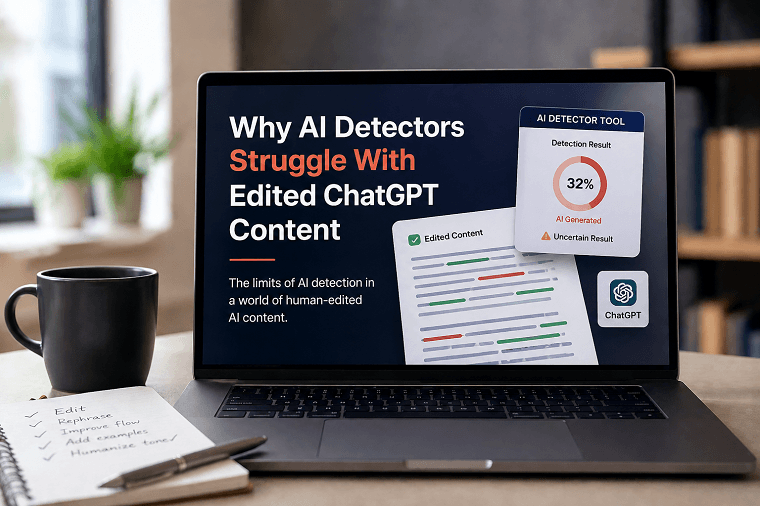
Artificial intelligence has transformed the way businesses, students, marketers, and creators produce content. Tools like ChatGPT make it possible to draft blog posts, emails, product descriptions, and marketing copy in minutes. But as AI-generated writing becomes more common, demand for reliable AI detector tools has surged. Publishers, educators, and businesses now rely on AI detection software to identify whether content was generated by artificial intelligence.
However, one major challenge remains: AI detectors often struggle with edited ChatGPT content.
If someone takes AI-generated text and rewrites, restructures, or humanizes it, many AI detection systems become less accurate. This creates confusion for content reviewers, website owners, and institutions trying to verify authenticity.
In this article, we will explore why AI detectors struggle with edited ChatGPT content, how AI detection technology works, and what users should know when evaluating AI-generated or AI-assisted writing.
How AI Detector Tools Work
To understand the issue, it helps to know how AI detector tools operate.
Most AI detectors analyze patterns commonly found in machine-generated writing, including:
Predictable sentence structures
Repetitive phrasing
Low variation in sentence length
Statistical probability of word sequences
Perplexity and burstiness metrics
Language model fingerprinting patterns
These systems compare the submitted content against patterns typically associated with large language models like ChatGPT, Claude, or Gemini.
Rather than “knowing” whether AI wrote something, detectors make probability-based predictions.
That means detection is inherently statistical - not definitive.
Why Edited ChatGPT Content Is Harder to Detect
1. Human Editing Breaks Predictable AI Patterns
When users revise AI-generated text manually, they often:
Change sentence structure
Replace repeated words
Add personal insights or opinions
Reorganize paragraphs
Adjust tone and flow
These edits disrupt the recognizable patterns that AI detector tools rely on.
As a result, the content may no longer match the statistical signature of raw AI-generated text.
2. Hybrid Content Blurs the Line Between Human and AI Writing
Modern content workflows often involve both AI and human input.
For example:
A marketer drafts content in ChatGPT
An editor rewrites sections
A subject matter expert adds insights
A proofreader improves grammar and readability
The final result is hybrid content—part AI-generated, part human-edited.
AI detectors struggle because they are forced to classify content into binary categories:
AI-generated
Human-written
But edited ChatGPT content often falls somewhere in between.
3. AI Humanizer Tools Further Complicate Detection
Many writers now use AI humanizer tools to rewrite AI-generated text and make it sound more natural.
These tools intentionally:
Increase sentence variation
Reduce robotic phrasing
Improve tone and readability
Mimic human writing patterns
Because of this, even advanced AI detector tools may find it difficult to identify the original AI source.
4. Detection Models Are Trained on Raw AI Output
Many AI detection systems are trained primarily on unedited AI-generated text.
But in real-world use cases, people rarely publish raw AI output without changes.
This creates a mismatch between:
Training data → Raw AI content
Real-world data → Edited / Humanized AI content
As AI writing workflows evolve, detection systems must continuously adapt.
The Problem of False Positives
One of the biggest concerns with AI detection is false positives.
A false positive happens when a detector incorrectly labels human-written content as AI-generated.
This is especially problematic for:
Students submitting academic work
Writers producing technical or formal content
Non-native English speakers
Professionals using structured writing styles
Because edited ChatGPT content can resemble polished human writing—and human writing can resemble structured AI output—AI detector tools can make mistakes in both directions.
Why Accuracy Matters in AI Detection
For organizations using AI detection software, accuracy is critical.
Inaccurate detection can lead to:
Wrongful academic accusations
Publishing delays
Client disputes for agencies
Loss of trust in editorial workflows
Poor moderation decisions
That’s why modern businesses need AI detection platforms that go beyond simplistic classification and provide nuanced analysis.
Best Practices for Evaluating Edited AI Content
Since AI detectors are not perfect, here are better ways to assess edited ChatGPT content:
Use Multiple Signals, Not Just AI Detection Scores
Combine AI detection with:
Plagiarism checks
Fact verification
Style consistency reviews
Manual editorial assessment
Brand voice analysis
Review Sentence-Level Patterns
Look for:
Abrupt tonal changes
Generic filler language
Overly uniform paragraph structure
Missing expertise or first-hand insight
Treat AI Detection as Advisory, Not Final Proof
AI detector tools should support human judgment - not replace it.
How CorrectifyAI Helps Improve AI Content Review
CorrectifyAI provides a smarter way to review AI-assisted writing by combining multiple content quality checks into one platform.
Instead of relying solely on AI detection, users can evaluate content through:
AI Detector Tool for probabilistic AI analysis
Plagiarism Checker for originality verification
Grammar Checker for writing quality
Fact Verification Tools for accuracy review
AI Humanizer Support for improving readability
This holistic approach helps teams make better decisions when reviewing edited ChatGPT content.
Final Thoughts
AI detectors struggle with edited ChatGPT content because AI detection is based on pattern recognition - not certainty.
Once AI-generated writing is revised, restructured, or humanized, many of the detectable signals disappear. As a result, even the best AI detector tools can face challenges distinguishing edited AI text from authentic human writing.
For businesses, educators, and publishers, the key takeaway is simple:
AI detection should be one part of a broader content review process - not the only factor.
As AI writing tools continue to evolve, successful content teams will rely on smarter workflows that combine detection, verification, and editorial review.
If your organization needs a more reliable way to evaluate AI-assisted writing, CorrectifyAI offers an all-in-one platform built for modern content quality assurance.
FAQs
1. Can AI detector tools accurately identify edited ChatGPT content?
AI detector tools can analyze patterns, but heavily edited ChatGPT content is often harder to detect accurately.
2. Why do AI detectors give false positives?
False positives happen when human-written content shares patterns similar to AI-generated writing.
3. Does rewriting AI content bypass AI detection?
Rewriting or humanizing AI content can reduce detectable AI patterns, making detection less reliable.
4. Should AI detection be the only way to review content?
No. AI detection works best when combined with plagiarism checks, fact-checking, and manual review.
5. Which AI detector tool should I use for content verification?
Choose an AI detector tool that combines detection with broader content quality checks, such as CorrectifyAI.