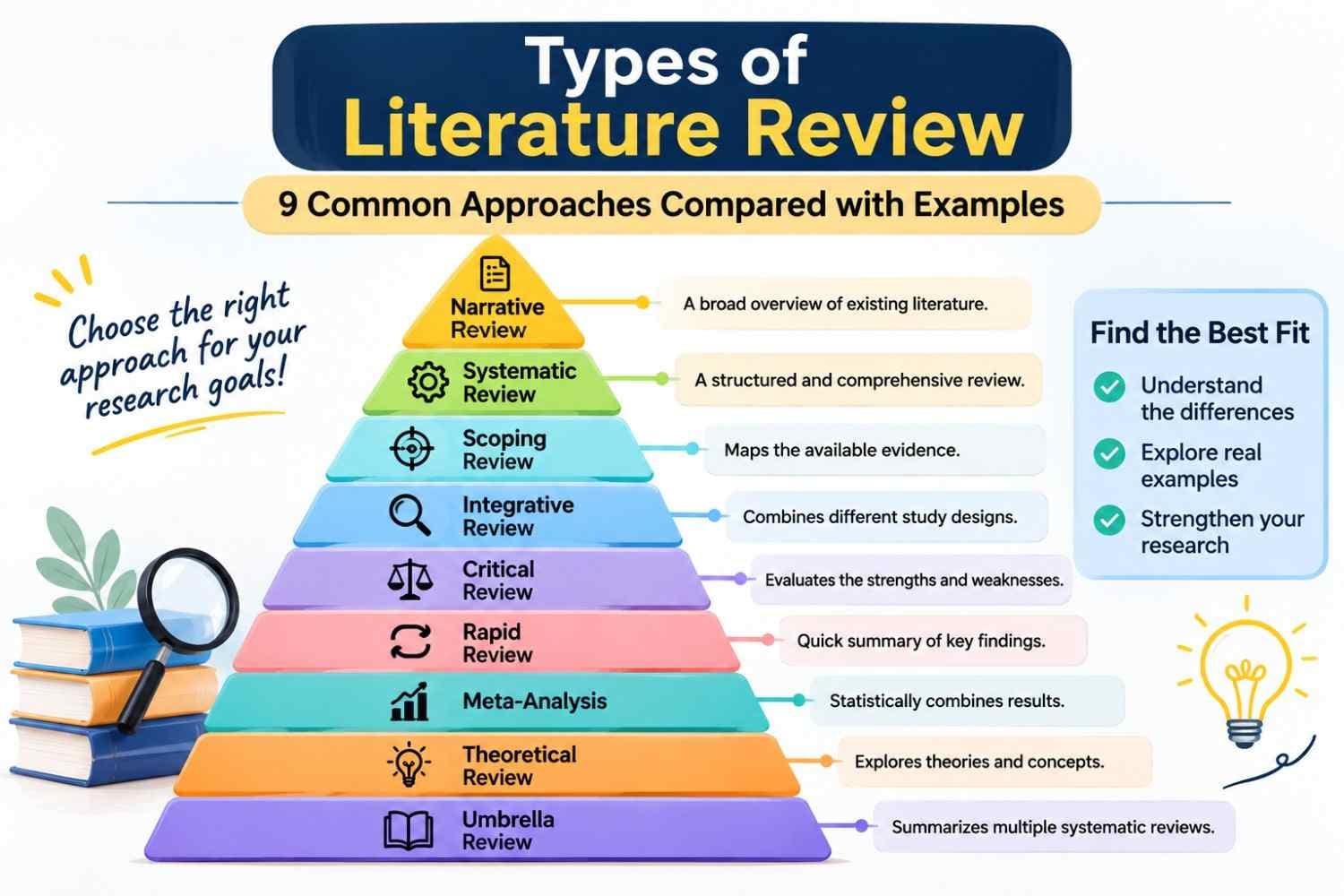
Choosing the right literature review approach is an important part of academic research. Students and researchers often find it difficult to decide which method suits their topic, research question and available evidence. The choice matters because each approach serves a different purpose: some provide an overview of existing knowledge, while others systematically evaluate studies, map research gaps or examine theoretical perspectives.
The types of literature review commonly used in research include narrative, systematic, scoping, integrative, critical, rapid, umbrella and theoretical reviews, along with meta-analysis as a statistical synthesis technique. Although these approaches have different objectives and methods, some can overlap. Understanding their differences, strengths and applications can help you select an appropriate methodology for your dissertation, thesis or research paper.
What Is a Literature Review?
A literature review is an organised examination of existing research, publications and academic discussions related to a particular subject. It involves finding relevant sources, evaluating their contributions and connecting their findings to understand what is already known about a research topic.
When literature review is defined in an academic context, it is more than a summary of published studies. It requires researchers to identify common findings, compare different viewpoints, examine limitations and recognise areas that need further investigation.
Researchers conduct literature reviews for several reasons:
Understand existing knowledge: Learn what previous researchers have discovered about a subject.
Identify research gaps: Find unanswered questions, underexplored areas or conflicting findings.
Establish a research foundation: Connect a new study with relevant theories, concepts and evidence.
Avoid unnecessary duplication: Understand what has already been investigated.
Before submitting the final document, researchers can check their work for plagiarism to identify potentially duplicated content.
Develop research questions: Use existing findings to refine the direction and scope of a study.
A well-conducted literature review helps establish why a research project is relevant and how it contributes to the existing body of knowledge.
What Are the Different Types of Literature Review?
There are several types of literature review in research and each is designed to address different academic objectives. Their classification may vary across disciplines and methodology frameworks. Some approaches focus on summarising research, while others examine evidence systematically, evaluate theories or combine findings from multiple studies.
The following nine approaches explain their purposes, methods and practical applications.
1. Narrative Literature Review
A narrative literature review provides a descriptive overview of existing research on a particular subject. It brings together relevant publications to explain how a topic has developed, what researchers have discussed and which perspectives are commonly found in the literature.
Researchers generally select studies based on their relevance to the topic and organise the discussion around important themes, concepts or developments. Unlike a systematic review, a narrative review does not always follow a predefined search and selection protocol.
Main purpose: To explain and summarise existing knowledge about a broad research topic.
When should you use it?
A narrative review is useful when you want to understand a subject, introduce its background or discuss different perspectives without answering a narrowly defined research question.
Example:
Suppose a postgraduate student is researching the impact of social media on student learning. A narrative literature review could examine studies about social media use in education, student engagement, online collaboration and academic performance. The researcher can organise the discussion around these themes to explain the overall development of the topic.
Key consideration: Narrative reviews offer flexibility, but the selection of sources may be less transparent. Researchers should explain how they identified relevant literature and avoid relying only on studies that support their preferred argument.
2. Systematic Literature Review
A systematic literature review uses a structured and transparent process to identify, select, evaluate and synthesise research related to a specific question. It aims to reduce selection bias by following predefined methods rather than choosing studies informally.
Researchers generally begin by developing a focused research question. They then search relevant academic databases, establish inclusion and exclusion criteria, screen publications and assess the quality of eligible studies. The findings are synthesised according to the research objective.
Main purpose: To answer a focused research question using a systematic approach to existing evidence.
When should you use it?
A systematic review is appropriate when you need a comprehensive and reproducible assessment of available research. It is commonly used in healthcare, education, psychology and other fields where evidence needs to be evaluated carefully.
Example:
A researcher wants to investigate whether online learning improves academic performance among undergraduate students. They may search academic databases for studies published within a defined period, include research involving undergraduate learners and exclude studies that do not measure academic outcomes. The selected studies are then evaluated and their findings synthesised.
Key consideration: A systematic review requires considerable planning, time and methodological discipline. Its search strategy, screening process and eligibility criteria should be clearly documented so that readers can understand how the evidence was selected.
3. Scoping Literature Review
A scoping literature review maps the available research on a broad topic. Instead of answering one specific question about effectiveness or outcomes, it examines the extent, range and nature of existing evidence.
Researchers use this approach to understand how much research is available, which themes have been investigated, what methods researchers have used and where important gaps remain.
A scoping review may involve a structured search and selection process. However, its main objective is to map the evidence rather than necessarily conduct an in-depth assessment of the quality of every included study.
Main purpose: To identify the scope of existing research and highlight areas that require further investigation.
When should you use it?
A scoping review is particularly useful when a research area is new, broad or still developing. It can also help determine whether a more focused systematic review is feasible.
Example:
Consider a researcher studying the use of artificial intelligence in higher education. Since the topic includes AI-based tutoring, automated assessment, personalised learning and academic support, a scoping review could map the available studies across these areas. The findings may reveal that some applications have received considerable attention while others remain under-researched.
Key consideration: A scoping review provides a broad picture of the research landscape. It should not automatically be treated as evidence that a particular intervention is effective.
4. Integrative Literature Review
An integrative literature review combines findings from different types of research to develop a broader understanding of a topic. It may include quantitative studies, qualitative research and theoretical publications, depending on the research question and review methodology.
Rather than examining only one type of evidence, this approach brings different perspectives together. Researchers analyse the selected literature, identify relationships between findings and develop new interpretations or conceptual frameworks.
Main purpose: To integrate diverse research findings and develop a more comprehensive understanding of a subject.
When should you use it?
An integrative review is useful when a topic has been studied through different research methods and you want to connect those findings. It can also help develop new frameworks or identify relationships that individual studies may not explain.
Example:
A researcher investigating employee motivation in remote workplaces could combine quantitative studies measuring employee productivity with qualitative studies examining job satisfaction, communication and work-life balance. Bringing these findings together may help develop a broader framework for understanding motivation in remote work environments.
Key consideration: Combining different forms of evidence requires a clear analytical method. Researchers should explain how the studies were selected, evaluated and integrated rather than simply placing unrelated findings together.
5. Critical Literature Review
A critical literature review goes beyond describing existing research. It evaluates the quality, assumptions, arguments and limitations of published studies to develop an informed understanding of a subject.
Researchers compare different viewpoints, identify contradictions and examine whether existing arguments are supported by sufficient evidence. The purpose is not simply to find weaknesses in previous studies but to understand the strengths and limitations of the current body of knowledge.
Main purpose: To evaluate existing research and develop a reasoned interpretation of its contributions and limitations.
When should you use it?
A critical review is useful when your research requires a deeper examination of established arguments, competing explanations or gaps in existing academic discussions.
Example:
Suppose a researcher is studying the relationship between employee productivity and remote work. Some studies may report improved productivity due to flexible working arrangements, while others may highlight communication difficulties and reduced collaboration. A critical review would examine the research methods, sample sizes, assumptions and limitations behind these findings before evaluating the different arguments.
Key consideration: Critical analysis should be evidence-based. It should explain why a study or argument is limited instead of simply labelling it as weak or unreliable.
6. Meta-Analysis
A meta-analysis is a statistical technique used to combine quantitative findings from multiple studies that investigate sufficiently similar research questions. It allows researchers to estimate an overall effect or identify patterns that may not be clear from individual studies.
Researchers first identify eligible studies, extract relevant numerical data and apply statistical methods to combine the results. The analysis may also examine differences between studies and assess how those differences affect the overall findings.
Main purpose: To statistically combine comparable quantitative results and estimate an overall effect.
When should you use it?
Meta-analysis is appropriate when multiple studies provide compatible quantitative data about a similar research question or outcome. It is frequently used in healthcare, psychology, education and other evidence-based disciplines.
Example:
Imagine several studies investigate whether a particular teaching intervention improves mathematics performance among school students. Each study reports its findings using a suitable numerical measure. A researcher may conduct a meta-analysis to combine the results and estimate the overall effect of the intervention.
Key consideration: Meta-analysis is not a completely independent literature review methodology. It is a statistical synthesis technique often conducted as part of a systematic review. It is not suitable when the included studies are too different or do not provide compatible data.
7. Rapid Literature Review
A rapid literature review uses streamlined review methods to gather and assess existing evidence within a shorter period. It is designed for situations where researchers or decision-makers need a timely understanding of available research.
Depending on the objective, the process may involve limiting the search period, using selected databases, narrowing the research scope or simplifying certain screening and assessment steps. Any changes to the standard systematic review process should be clearly reported.
Main purpose: To produce a timely overview of available evidence when a full systematic review is not practical.
When should you use it?
A rapid review can be useful when organisations, policymakers or researchers need evidence to support decisions within a limited timeframe.
Example:
A university wants to understand the available evidence on online assessment methods before introducing a new examination policy. Since the decision is time-sensitive, researchers may conduct a rapid review of relevant academic studies to identify common findings, challenges and possible approaches.
Key consideration: Faster methods can limit the coverage and depth of a review. A rapid review may overlook relevant studies or introduce a greater risk of selection bias compared with a full systematic review.
8. Umbrella Review
An umbrella review, also known as a review of reviews, examines existing systematic reviews and meta-analyses rather than primarily analysing individual research studies.
It brings together evidence from multiple reviews to provide a broader understanding of a topic. This approach is especially useful when a subject has already been investigated through several systematic reviews.
Researchers identify relevant reviews, assess their quality and compare their findings. They may also examine whether different reviews reach similar conclusions or report conflicting results.
Main purpose: To summarise and compare findings from existing systematic reviews and meta-analyses.
When should you use it?
An umbrella review is useful when a research topic has a large body of review-level evidence and you need an overview of the conclusions across different studies and reviews.
Example:
A researcher wants to understand the effects of physical activity on mental health. Several systematic reviews may already examine exercise and depression, anxiety, stress or overall psychological well-being. An umbrella review could bring these reviews together to provide a broader picture of the available evidence.
Key consideration: Umbrella reviews depend on the quality and coverage of the reviews they include. Researchers should also consider overlapping primary studies, as the same original research may appear in more than one systematic review.
9. Theoretical Literature Review
A theoretical literature review examines existing theories, concepts and conceptual frameworks related to a research topic. Instead of focusing mainly on the results of individual empirical studies, it evaluates how different theoretical perspectives explain a particular subject.
Researchers compare established theories, examine their assumptions and identify similarities, differences or limitations. This process helps establish the theoretical foundation for a research project and may support the development of a new conceptual framework.
Main purpose: To examine and evaluate theories that explain a research problem or phenomenon.
When should you use it?
A theoretical review is useful when your research focuses on understanding concepts, comparing theoretical explanations or developing a framework to guide further investigation.
Example:
A researcher studying employee motivation may examine Maslow's hierarchy of needs, Herzberg's two-factor theory and self-determination theory. Comparing these perspectives can help explain different aspects of workplace motivation and establish the theoretical foundation for the research.
Key consideration: A theoretical review should do more than describe individual theories. It should explain how they relate to the research question and why particular theoretical perspectives are relevant.
Comparison of Different Types of Literature Review
Although the different types of literature review share the goal of examining existing knowledge, they vary in purpose, methodology and suitability. The following table provides a quick comparison.
Type | Main purpose | Method | Best suited for |
Narrative | Summarise existing knowledge | Descriptive synthesis | Broad research topics |
Systematic | Answer a focused question | Structured search and synthesis | Evidence-based research |
Scoping | Map existing evidence | Broad evidence mapping | Emerging research areas |
Integrative | Combine different research perspectives | Synthesis of diverse studies | Developing frameworks |
Critical | Evaluate existing arguments | Critical analysis | Theoretical research |
Meta-analysis | Combine quantitative findings | Statistical synthesis | Comparable study results |
Rapid | Produce evidence efficiently | Streamlined review methods | Time-sensitive research |
Umbrella | Summarise existing reviews | Review of reviews | Broad evidence synthesis |
Theoretical | Examine theories and concepts | Theoretical analysis | Conceptual research |
The most important difference is the question each approach is designed to answer. A narrative review helps explain what is known about a subject, while a systematic review investigates a focused question through a predefined process. A scoping review maps the available evidence, whereas an integrative review combines different research perspectives.
Critical and theoretical reviews focus more on evaluating arguments and concepts. Meta-analysis statistically combines compatible quantitative findings, while an umbrella review examines conclusions from existing reviews. A rapid review uses streamlined methods when time is limited.
These approaches are not always mutually exclusive. For example, a systematic review may include a meta-analysis and a review may combine critical analysis with a theoretical discussion.
How to Choose the Right Type of Literature Review
Choosing a literature review methodology should begin with your research question, not simply with the method that seems easiest. Consider what you want to understand, the type of evidence available and the depth of analysis your project requires.
The following factors can help you make a suitable choice:
Research question: Is your question broad and exploratory or does it focus on a specific relationship, intervention or outcome?
Research scope: Are you examining a wide subject or a clearly defined research problem?
Available studies: Is there enough published research to support a systematic review or meta-analysis?
Research objectives: Do you want to summarise knowledge, map evidence, evaluate theories or combine findings?
Time and resources: Can you complete a detailed search, screening and quality assessment within your available timeframe?
Type of evidence: Does your research require qualitative findings, quantitative results or a combination of both?
A simple decision guide can help narrow down the options:
Want to understand a broad topic? Consider a narrative review.
Want to map the available evidence? Consider a scoping review.
Need to answer a focused research question systematically? Consider a systematic review.
Need to statistically combine comparable findings? Consider a meta-analysis.
Want to evaluate existing theories or arguments? Consider a theoretical or critical review.
The final choice should be justified by your research objectives and an appropriate methodology. If you are unsure, discuss your proposed approach with your research supervisor before beginning the review.
Advantages and Limitations of Different Literature Reviews
Each review approach offers different benefits, but its usefulness depends on the research objective and the quality of the available evidence.
Narrative reviews provide flexibility and help explain broad topics, but their source selection may be less transparent. Systematic reviews offer a structured and reproducible process, although they require substantial time and resources. Scoping reviews are useful for mapping emerging research areas, but they may not provide an in-depth evaluation of evidence quality.
Integrative reviews connect different research perspectives, while critical and theoretical reviews support deeper analysis of arguments and concepts. However, both require careful interpretation. Meta-analysis can provide a combined statistical estimate, but only when study findings are sufficiently comparable. Umbrella reviews offer a broad overview of existing reviews, although overlapping studies can affect interpretation. Rapid reviews save time but may sacrifice some search coverage or methodological depth.
Researchers should consider transparency, selection bias, available evidence and the time required before deciding on an approach.
Common Mistakes When Choosing a Literature Review Type
Selecting an unsuitable review methodology can affect the quality and direction of academic research. Some common mistakes include:
Ignoring the research question: Choosing a review type without considering what the study aims to investigate.
Confusing narrative and systematic reviews: Treating descriptive summaries and structured evidence reviews as the same approach.
Treating meta-analysis and systematic reviews as identical: Overlooking the fact that meta-analysis is a statistical synthesis technique.
Ignoring inclusion and exclusion criteria: Failing to establish clear rules for selecting relevant studies.
Choosing a method only for convenience: Selecting an approach because it appears easier rather than because it suits the research objectives.
Another useful final check is to identify repeated words in your draft, particularly when reviewing a long academic document.
FAQ
What are the main types of literature review?
Common approaches include narrative, systematic, scoping, integrative, critical, rapid, umbrella and theoretical reviews. Meta-analysis is also commonly discussed alongside these approaches as a statistical method for combining quantitative findings. Classifications may vary across academic disciplines.
Which type of literature review is best for research?
There is no single best type of literature review for every research project. A narrative review may suit a broad topic, while a systematic review is more appropriate for a focused research question. The choice depends on your objectives, evidence and methodology.
What is the difference between narrative and systematic literature review?
A narrative review provides a descriptive discussion of relevant research and generally allows more flexibility in source selection. A systematic review follows a predefined search, screening and evaluation process to answer a focused question more transparently.
Is meta-analysis a type of literature review?
Meta-analysis is a statistical synthesis technique rather than a standalone review methodology. It is often conducted within a systematic review to combine compatible quantitative findings from multiple studies.
How do I choose the right literature review methodology?
Start by defining your research question and objectives. Then consider the scope of your topic, available studies, type of evidence, time and resources. Select an approach that supports your research aims and can be justified academically.
Can a research paper include more than one literature review approach?
Yes. Different review methods or components can be combined when there is a clear methodological reason. For example, a systematic review may include a meta-analysis, while a broader research project may use scoping methods before conducting a focused systematic review. The roles of each component should be explained clearly.