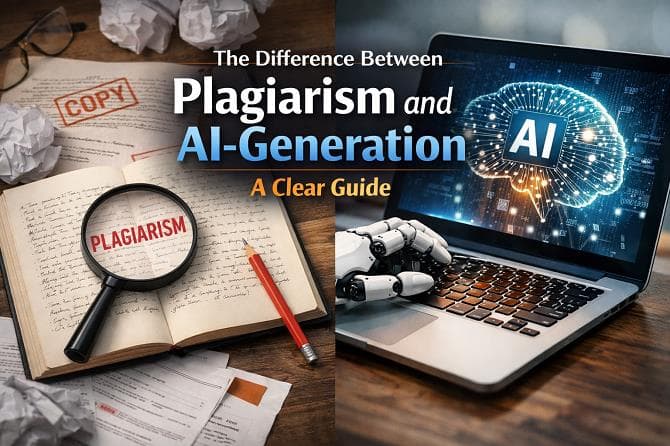
In the modern digital landscape, the lines between original creation, research, and automation have become increasingly blurred. For students, educators, and content professionals, two terms often surface in conversations about integrity: Plagiarism and AI-Generation.
While they are often grouped together under the umbrella of "academic or professional dishonesty," they are fundamentally different concepts with different footprints. Understanding these nuances is critical for anyone using an AI checker tool online to verify their work.
This guide breaks down the definitions, the technological differences, and how you can maintain a high standard of integrity in an AI-driven world.
What is Plagiarism?
Plagiarism is the act of taking someone else's work, ideas, or expressions and presenting them as your own without proper acknowledgment. It is essentially a "theft" of intellectual property.
Types of Plagiarism:
Direct Plagiarism: Word-for-word transcription of a section of someone else’s work.
Self-Plagiarism: Re-using your own previously submitted work for a new assignment.
Mosaic Plagiarism: Patching together bits of different sources without original thought.
Accidental Plagiarism: Neglecting to cite a source or misquoting due to oversight.
Traditional plagiarism detection software works by comparing your text against a massive database of existing webpages, journals, and books. If a string of words matches an existing source, it is flagged.
What is AI-Generation?
AI-generation occurs when a Large Language Model (LLM) creates text based on patterns it learned during training. Unlike plagiarism, the AI is not "copying and pasting" from a specific book or website. Instead, it predicts the next most likely word in a sequence to create something entirely new in its structure.
Why AI Isn't Always "Original"
Even though the specific sentence might not exist anywhere else on the internet, the information and logic are derived from the AI's training data. Because the AI doesn't have a "voice" or "lived experience," the content can often feel formulaic, repetitive, or lack deep insight.
Key Differences Between Plagiarism and AI Content
Feature | Plagiarism | AI-Generation |
Source | A specific human author or publication. | A mathematical model predicting word patterns. |
Detection Method | Database matching (Text Comparison). | Semantic analysis and "Perplexity" checks. |
Intent | Borrowing existing success/ideas. | Automating the writing process. |
Legal Status | Potential Copyright Infringement. | Evolving; generally lacks copyright protection. |
How an AI Checker Tool Online Works
Many users mistakenly believe that a standard plagiarism checker can catch AI-generated text. This is a common misconception.
To identify AI, you need a specialized AI checker tool online that uses linguistic forensics. These tools look for:
Low Perplexity: AI tends to choose the most predictable words. Humans are more "perplexing" and use unexpected vocabulary.
Burstiness: Human writing has "bursts" of short and long sentences. AI writing often has a very consistent, rhythmic length that feels robotic.
Pattern Recognition: Advanced detectors can identify the specific "fingerprint" left behind by models like GPT-4 or Claude.
Using a tool like CorrectifyAI allows you to scan for both traditional plagiarism and AI markers, ensuring that your content isn't just "not copied," but truly human-made.
The Gray Area: AI-Assisted Plagiarism
The most complex issue arises when an AI generates text that includes a direct quote or a specific theory without citing the original human creator. In this case, the content is both AI-generated and plagiarized.
If you use an AI to summarize a research paper and it fails to attribute the findings to the scientist, you are committing plagiarism. This is why "Deep AI Screening" is becoming the industry standard; you must verify the facts and the sources, not just the word choice.
Best Practices for Maintaining Integrity
1. Always Verify Facts
AI models are prone to "hallucinations" - they can invent facts, dates, and citations that look real but don't exist. Always cross-reference any data provided by an AI with a primary source.
2. Use AI for Outlining, Not Writing
The best way to avoid being flagged by an AI detector is to use technology as a brainstorming partner. Let the AI help you structure your thoughts, but write the actual sentences yourself. Your unique perspective and tone are what make the content valuable.
3. Transparent Attribution
If you used AI to help generate parts of a report or a blog post, be transparent about it. Many style guides (like APA or MLA) now have specific rules for how to cite AI-generated content.
4. Run a Final Scan
Before submitting any work - whether it’s a university essay or a professional business proposal - run it through a comprehensive AI checker tool online. This provides peace of mind and allows you to "humanize" any sections that may have inadvertently sounded too mechanical.
Conclusion: The Path Forward with Correctify AI
The goal of modern writing isn't to avoid technology, but to use it responsibly. Understanding the difference between plagiarism and AI-generation is the first step toward becoming a better, more ethical creator.
Plagiarism ignores the past (by stealing it), while improper AI use ignores the present (by automating it). To stand out in an era of infinite content, your work needs to be authentic.
By leveraging tools like Correctify AI, you can ensure your content is accurate, original, and free from the pitfalls of both plagiarism and robotic automation. Whether you are proofreading a restaurant menu or a scientific thesis, deep screening is the only way to guarantee your brand’s reputation remains untarnished.
FAQ
Q: Can a plagiarism checker detect AI?
Generally, no. Standard plagiarism checkers look for matching text in a database. AI content is unique in structure, so it requires a specialized AI detection tool to analyze linguistic patterns.
Q: Is using AI considered cheating?
This depends on the context. In many academic and professional settings, using AI to write your work is considered a breach of integrity unless explicitly allowed and cited.
Q: How do I make my AI-generated text pass an AI checker?
The most effective way is to heavily edit the text, add personal anecdotes, vary your sentence structure, and ensure the "voice" of the piece aligns with your own writing style.
Q: What is the most accurate AI checker tool online?
Tools that utilize deep semantic analysis and are updated frequently to catch the latest LLM models (like GPT-4o) are the most reliable for professional use.