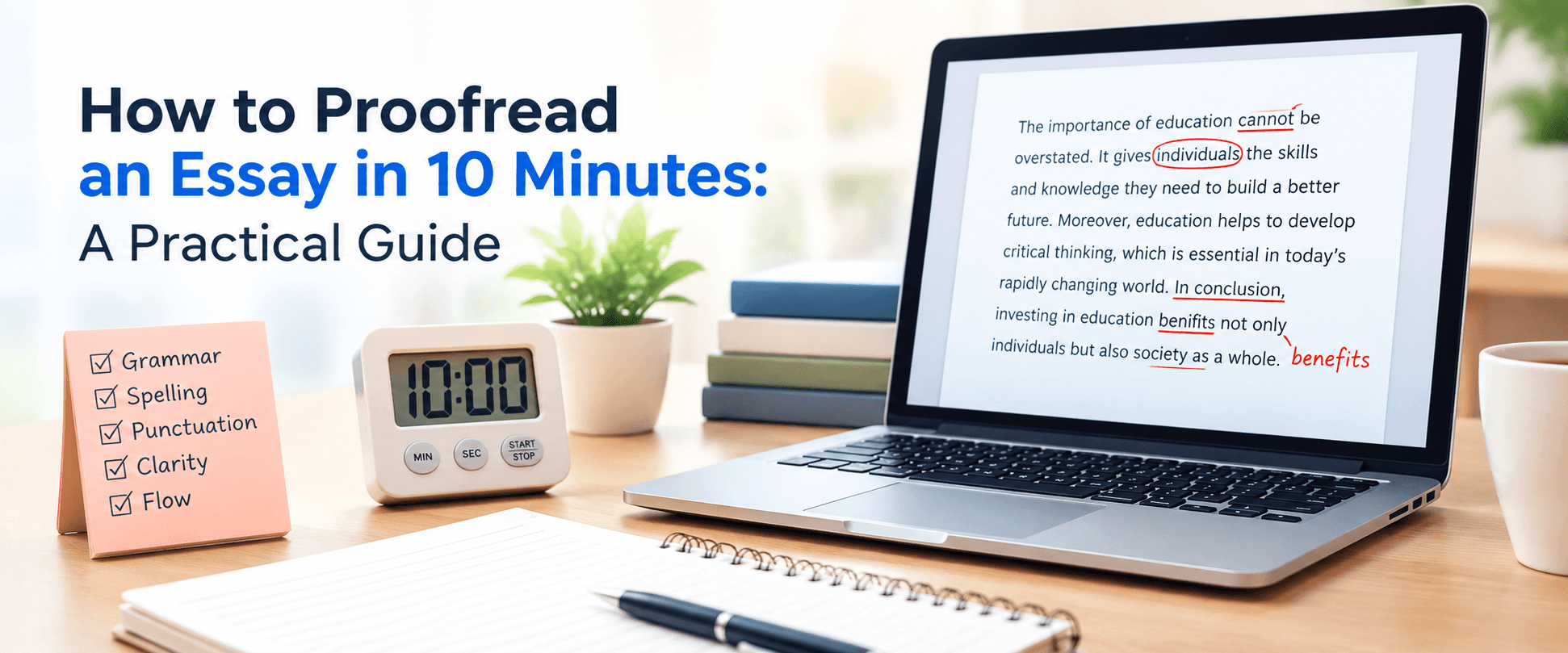
Writing an essay is only part of the process. Before submitting your assignment, taking a few minutes to proofread can help you catch grammar mistakes, spelling errors, punctuation problems, unclear sentences, and formatting issues.
The good news is that you do not always need to spend hours reviewing your work. With a focused approach, you can proofread an essay in 10 minutes and identify many of the most common errors.
This guide explains how to proofread an essay quickly using a simple, step-by-step process that students can follow before submitting an assignment.
What Does It Mean to Proofread an Essay?
Proofreading an essay means carefully reviewing your completed writing to find and correct small errors before submission. It usually focuses on grammar, spelling, punctuation, sentence structure, word choice, formatting, and consistency.
Proofreading is different from writing or rewriting an essay. The main goal is to identify mistakes that may have been overlooked while drafting.
A good proofreading process can help make your essay clearer, more accurate, and easier to read.
Editing vs. Proofreading: What's the Difference?
Editing and proofreading are related, but they serve different purposes.
Editing | Proofreading |
Improves ideas and organization | Finds final errors |
Checks paragraph structure | Checks grammar and spelling |
May involve rewriting sentences | Focuses on corrections |
Improves clarity and flow | Checks the finished draft |
Usually happens before proofreading | Usually the final review |
For example, if a paragraph does not logically support your thesis, that is primarily an editing issue. If the paragraph contains a spelling mistake or missing comma, that is a proofreading issue.
Ideally, you should edit your essay first and proofread it afterward.
How to Proofread an Essay in 10 Minutes
You can divide your proofreading process into short, focused checks. Instead of trying to identify every possible problem at once, concentrate on one category of errors at a time.
Minute 1: Check Your Essay Structure
Start by looking at the overall structure of your essay.
Check whether your essay has:
A clear introduction
A strong thesis statement
Well-organized body paragraphs
Supporting evidence or examples
A logical conclusion
Read the first sentence of each paragraph. Does the essay follow a logical progression from one idea to the next?
Also make sure each body paragraph connects to your main argument.
If you notice a major problem with the organization, make a note of it. However, avoid completely rewriting your essay during this 10-minute proofreading session. The goal is to perform a final check rather than restart the editing process.
Minutes 2–3: Check Grammar and Sentence Structure
Next, focus specifically on grammar and sentence construction.
Look for common problems such as:
Subject-verb agreement
Incorrect verb tense
Sentence fragments
Run-on sentences
Incorrect pronoun usage
Missing articles
Awkward sentence construction
For example:
Incorrect:
Students needs to understand the importance of proofreading.
Correct:
Students need to understand the importance of proofreading.
Also look for sentences that are unnecessarily complicated. Academic writing can be detailed without making every sentence difficult to understand.
Read each sentence carefully and ask whether its meaning is immediately clear.
Minute 4: Check Spelling and Typos
Spelling mistakes are easy to overlook when you are familiar with what you have written.
During this step, look specifically for:
Misspelled words
Typographical errors
Missing words
Repeated words
Incorrect capitalization
Commonly confused words
Pay particular attention to words such as:
Your / You're
Their / There / They're
Its / It's
Affect / Effect
Then / Than
Do not rely only on spell-check software. Some incorrectly used words are spelled correctly, meaning a basic spell checker may not identify the problem.
Minute 5: Check Punctuation
Now perform a dedicated punctuation check.
Look for:
Missing commas
Unnecessary commas
Incorrect apostrophes
Missing periods
Incorrect quotation marks
Misused colons and semicolons
For example:
Incorrect:
Students should proofread their essays however they should also check their citations.
Correct:
Students should proofread their essays; however, they should also check their citations.
Consistent punctuation makes academic writing easier to follow and can prevent confusion between different ideas.
Minutes 6–7: Improve Word Choice and Clarity
Once basic errors are checked, focus on clarity.
Ask yourself:
Is this sentence easy to understand?
Have I repeated the same word too often?
Are any words unnecessary?
Is the language appropriate for academic writing?
Are there vague or unclear statements?
For example:
Before:
There are many things that students can do in order to make their essays better.
After:
Students can improve their essays by using clear arguments and precise language.
The second sentence communicates the same general idea more directly.
You do not need to replace every simple word with a complicated one. Good academic writing should prioritize clarity and precision rather than unnecessarily complex vocabulary.
Minute 8: Check Citations and Sources
If your essay uses information from books, websites, journal articles, or other sources, check your citations before submitting.
Review:
In-text citations
Reference entries
Missing citations
Author names
Publication dates
Citation formatting
Consistency between citations and references
Also check which citation style your assignment requires. Common academic styles include APA, MLA, and Chicago.
A polished essay can still have problems if sources are missing or citations are inconsistent, so this step should not be skipped.
Minute 9: Check Formatting
Spend one minute checking the visual formatting of your essay.
Depending on your assignment requirements, check:
Font type and size
Line spacing
Paragraph spacing
Margins
Headings
Page numbers
Indentation
Title formatting
Compare your document with your instructor's requirements or assignment guidelines.
Formatting requirements can vary between schools, instructors, courses, and citation styles, so always follow the specific instructions provided for your assignment.
Minute 10: Read Your Essay One Final Time
Use the final minute for a quick overall reading.
Do not focus on every individual grammar rule. Instead, look for anything that feels incomplete, confusing, or unusual.
Pay attention to:
Missing words
Repeated phrases
Awkward sentences
Sudden changes in ideas
Incorrect names or terminology
Errors you may have missed during the previous checks
Reading your essay aloud can also help. When you hear the words rather than simply looking at them, awkward phrasing and missing words can become easier to notice.
10-Minute Essay Proofreading Checklist
Before submitting your essay, use this quick checklist:
My thesis statement is clear.
My paragraphs are logically organized.
My grammar is correct.
My spelling has been checked.
My punctuation is consistent.
My sentences are clear and readable.
I have avoided unnecessary repetition.
My citations are included.
My references follow the required format.
My document follows the assignment's formatting requirements.
I have completed a final read-through.
Saving this checklist can make proofreading easier for future assignments.
Common Mistakes Students Miss When Proofreading
Even after reviewing an essay, students can overlook certain types of mistakes.
Repeated Words
You may use the same word several times within a paragraph without noticing it. Look for repetition and replace unnecessary duplicates where appropriate.
Run-On Sentences
Long sentences can contain multiple ideas without proper punctuation. Consider separating them into shorter sentences when necessary.
Inconsistent Verb Tenses
Switching between past and present tense without a clear reason can make writing confusing.
Subject-Verb Agreement
Check that singular subjects have singular verbs and plural subjects have plural verbs.
Missing or Incorrect Punctuation
A missing comma or apostrophe can change the meaning or readability of a sentence.
Incorrect Citations
Make sure information from outside sources is properly cited according to the required academic style.
How to Proofread an Essay More Effectively
A few simple techniques can make your proofreading process more productive.
Read One Type of Error at a Time
Trying to check grammar, spelling, punctuation, citations, and structure simultaneously can make it easier to miss errors.
Instead, dedicate each pass to a specific category.
Read Your Essay Out Loud
Reading aloud forces you to process each sentence more carefully. It can help identify awkward wording, missing words, and overly long sentences.
Change the Format
Changing the font size or viewing your document differently can make familiar text appear less familiar. This can help you notice errors you previously overlooked.
Take a Short Break
If time allows, step away from your essay before proofreading it. Returning with a fresh perspective can make mistakes easier to recognize.
Use a Proofreading Tool
Digital writing tools can provide an additional layer of review by identifying potential grammar, spelling, clarity, and writing issues. For example, CorrectifyAI can be used as part of your final writing review to help identify issues that may have been missed during manual proofreading.
However, automated suggestions should be reviewed carefully. A tool may identify a potential issue, but you should always consider the context and your assignment requirements before accepting a suggested change.
Can AI Help Proofread an Essay?
AI-powered writing tools can assist students during the proofreading process. Depending on the tool, they may identify potential grammar errors, spelling problems, unclear sentences, readability issues, and other writing concerns.
However, AI should be treated as a support tool rather than a replacement for your own review.
Students should:
Review each suggested correction.
Make sure the correction preserves the intended meaning.
Check the original assignment requirements.
Verify citations and factual information independently.
Read the final version themselves.
The goal is to produce writing that accurately represents your ideas and follows your academic requirements.
Frequently Asked Questions
How do you proofread an essay quickly?
To proofread an essay quickly, check one category at a time. Start with structure, then review grammar, spelling, punctuation, clarity, citations, and formatting. Finish by reading the essay once more to catch any remaining errors.
How can I find grammar mistakes in my essay?
Read each sentence carefully, look for common grammar problems, and consider using a writing tool for an additional check. Always review suggested corrections yourself to make sure they fit the context.
How long does it take to proofread an essay?
The time required depends on the length and complexity of the essay. A short essay may be reviewed quickly, while a longer research paper may require more time. A structured 10-minute check can still help identify many common errors.
What is the difference between proofreading and editing?
Editing focuses on improving ideas, organization, structure, and clarity. Proofreading is the final review that focuses primarily on grammar, spelling, punctuation, formatting, and other small errors.
Should I proofread my essay before submitting it?
Yes. A final proofreading pass can help identify mistakes that were missed while writing or editing. Even a short review can improve the clarity and accuracy of your final submission.
Final 10-Minute Essay Proofreading Strategy
Proofreading does not have to take hours. A focused 10-minute process can help you review the most important areas before submitting an essay.
Use this simple sequence:
1 minute: Check structure
2 minutes: Check grammar and sentence structure
1 minute: Check spelling
1 minute: Check punctuation
2 minutes: Check clarity and word choice
1 minute: Check citations
1 minute: Check formatting
1 minute: Complete a final read-through
The most important thing is to proofread with a plan. Instead of quickly scanning the entire essay and hoping to notice mistakes, focus on specific error types one at a time.
A final combination of careful human review and appropriate writing tools can help you submit an essay that is clearer, more consistent, and ready for evaluation.