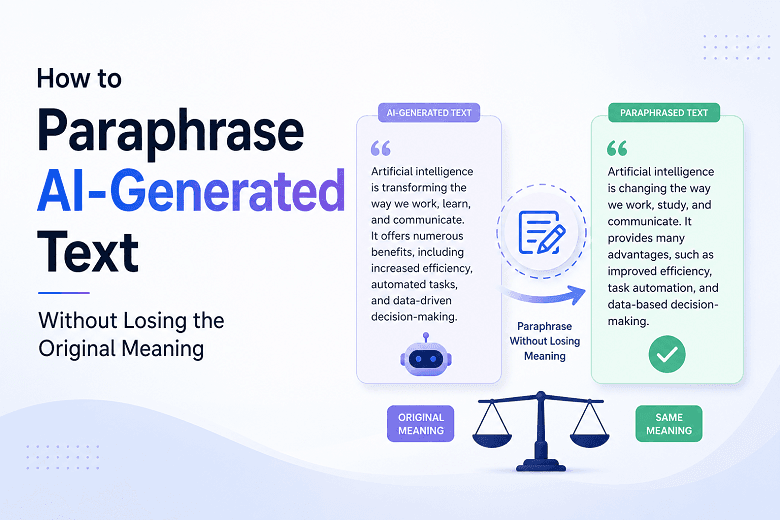
In the era of Generative AI, tools like ChatGPT, Claude, and Gemini have become indispensable assistants for writers, marketers, and students. However, there is a growing challenge: AI-generated text often lacks a unique "human" touch, can be repetitive, and is increasingly flagged by AI detectors.
To make AI content truly effective, you must learn the art of paraphrasing. The goal isn’t just to swap words with synonyms; it is to refine the delivery while keeping the core message intact.
In this guide, we will explore the best strategies to paraphrase AI text effectively, ensuring your content remains authentic, SEO-friendly, and engaging.
Why You Should Paraphrase AI Content
Before we dive into the "how," let’s understand the "why."
Avoiding Detection: Search engines and academic institutions use sophisticated algorithms to identify AI patterns. Paraphrasing helps bypass these filters.
Improving Readability: AI tends to use "fluff" and complex sentence structures. Paraphrasing allows you to simplify the message for your target audience.
Injecting Brand Voice: AI doesn't know your brand’s specific tone. Manual or tool-assisted paraphrasing lets you add your unique personality.
SEO Optimization: To rank on Google, your content needs to provide "Experience, Expertise, Authoritativeness, and Trustworthiness" (E-E-A-T). Pure AI text often lacks the depth required for high rankings.
5 Strategies to Paraphrase Without Losing Meaning
1. Understand the Core Intent First
The biggest mistake writers make is paraphrasing sentence by sentence. This often leads to "word salad," where the text sounds unnatural. Instead, read the entire paragraph generated by the AI. Ask yourself: What is the one key takeaway here? Once you understand the intent, rewrite it from scratch in your own words.
2. Change the Sentence Structure
AI often follows a predictable rhythm - usually "Subject-Verb-Object." To break this pattern, try:
Converting Active Voice to Passive (and vice versa): While active voice is generally better, mixing it up creates a more natural flow.
Combining or Splitting Sentences: If the AI gives you three short sentences, merge them into one complex, cohesive thought.
3. Use Domain-Specific Synonyms
AI frequently uses generic terms like "important," "utilize," or "comprehensive." To maintain meaning while improving quality, replace these with industry-specific terminology. If you are writing about digital marketing, instead of saying "AI helps with work," say "AI streamlines the content ideation workflow."
4. The "Rubber Duck" Method
Imagine you are explaining the AI’s output to a friend over coffee. How would you say it? Usually, our spoken language is much more direct and impactful than AI output. Use this "verbal" version as your new draft.
5. Utilize Specialized Tools
Sometimes, doing it all manually is time-consuming. Using a dedicated tool like CorrectifyAI can help you bridge the gap. These tools are designed to recognize the context of your writing, ensuring that when you "humanize" or paraphrase, the underlying logic remains solid.
Maintaining SEO Integrity During Paraphrasing
If you are paraphrasing for a blog or website, you must be careful not to lose your keywords.
Keep Keywords Intact: If your target keyword is "best vegan protein powder," do not paraphrase it to "top plant-based muscle milk." Search engines look for specific phrases.
Optimize Meta Tags: Even if you paraphrase the body text, ensure your H1 and H2 tags remain SEO-rich.
Add LSI Keywords: Use the paraphrasing process to add Latent Semantic Indexing (LSI) keywords - terms related to your main topic - which AI might have missed.
Common Pitfalls to Avoid
Over-Engineering: Don't use a thesaurus for every word. If you use "gargantuan" instead of "big" in a casual blog post, it will look suspicious and decrease readability.
Losing Facts: AI often hallucinates. When paraphrasing, double-check that your new version hasn't accidentally changed a date, statistic, or factual claim.
Ignoring the Flow: A well-paraphrased piece should have a logical transition between paragraphs. AI often struggles with "connective tissue"; this is where you can add the most value.
How Correctify AI Can Help
At Correctify AI, we understand that the future of writing isn't "Human vs. AI," but "Human + AI." Our platform is specifically engineered to help users:
Humanize AI Text: We go beyond simple word swapping to adjust tone, rhythm, and flow.
Fix Grammar and Clarity: Even the best AI makes mistakes. We ensure your paraphrased text is polished and professional.
Save Time: Manually rewriting 2,000 words is exhausting. Our tools allow you to maintain the "human feel" at scale.
Whether you are a student looking to refine an essay or a digital marketer producing bulk content, CorrectifyAI ensures your message is heard - without the robotic undertones.
Conclusion
Paraphrasing AI-generated text is a vital skill in the modern digital landscape. By focusing on the core intent, varying sentence structures, and using the right tools, you can create content that is both efficient and authentic. Remember, AI is the foundation, but your perspective is architecture.
Don't let your content sound like a machine. Head over to CorrectifyAI today and give your writing the human edge it deserves.
Frequently Asked Questions
Does paraphrasing AI text change the original facts?
Not if done correctly. Effective paraphrasing focuses on changing the structure and vocabulary while keeping the underlying data and logic intact. Always double-check specific dates and statistics after rewriting.
Why can't I just use a standard thesaurus to paraphrase?
A thesaurus only swaps individual words, which often leads to awkward phrasing and "robotic" flow. Context-aware paraphrasing ensures that sentences sound natural and maintain their intended meaning.
Will paraphrasing help my content rank better on Google?
Yes. Google prioritizes content that demonstrates E-E-A-T (Experience, Expertise, Authoritativeness, and Trustworthiness). Paraphrasing allows you to inject personal insights and unique value that raw AI output lacks.
How much of the AI text should I change?
To truly "humanize" content and avoid detection, aim to rewrite or significantly modify at least 50-70% of the text, focusing heavily on sentence structure and introductory hooks.
Is it ethical to paraphrase AI-generated content?
Yes, provided you are using the AI as a drafting assistant. Paraphrasing is a way to refine your ideas and ensure the final output reflects your own voice and professional standards.