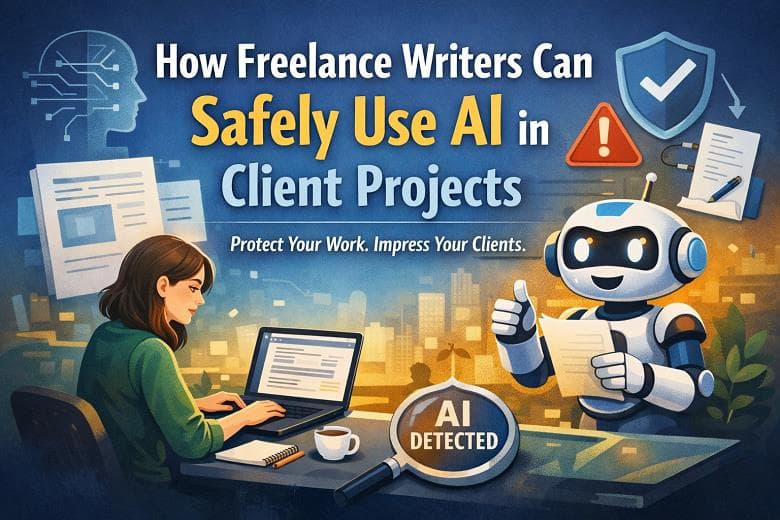
AI writing tools have completely changed how freelance writers work. From faster research to quick first drafts, AI can save hours every week. But there’s a growing concern many freelancers now face:
“Will my client reject this because it sounds AI-written?”
AI detection tools, stricter editorial standards, and client trust issues mean freelancers must be careful. Using AI is no longer just about speed - it’s about using it safely.
This guide explains how freelance writers can safely use AI in client projects without risking credibility, originality, or long-term client relationships. When used responsibly - with the right human touch and tools like CorrectifyAI - AI can become a powerful ally instead of a liability.
Why Freelance Writers Are Turning to AI Tools
Freelancers don’t use AI to cut corners - they use it to survive and scale.
Here’s why AI tools have become popular among freelance writers:
Faster content research and idea generation
Creating outlines and structured drafts in minutes
Handling multiple client deadlines efficiently
Reducing burnout while maintaining productivity
AI helps freelancers focus more on strategy, storytelling, and editing, rather than starting every article from a blank page. However, speed without quality can be dangerous.
The Real Risks of Using AI in Client Projects
Using AI incorrectly can harm your freelance career. Some of the most common risks include:
1. AI Detection Flags
Many clients now use AI detection tools. Submitting raw AI-generated content can lead to:
Rejected articles
Payment delays
Loss of long-term clients
2. Robotic or Generic Tone
AI content often lacks:
Emotional depth
Brand voice alignment
Natural sentence flow
Editors can instantly spot content that feels “off.”
3. Originality and Trust Issues
Clients hire freelancers for human insight, not machine-generated repetition. If your work feels automated, trust erodes quickly.
That’s why freelancers must treat AI as a drafting assistant, not a replacement.
How to Safely Use AI as a Freelance Writer
Using AI safely is about process, not avoidance. Here’s how experienced freelancers do it.
Use AI for Drafting, Not Final Delivery
AI works best for:
Blog outlines
Topic research
First drafts
Content expansion
Your final submission should never be raw AI output. Human editing is mandatory.
Always Humanize AI-Generated Content
This is where most freelancers fail—and where smart freelancers stand out.
To humanize AI content:
Rewrite sentences to sound conversational
Add real-world context and examples
Adjust tone based on client brand voice
Improve flow, transitions, and rhythm
Using an AI humanizer like CorrectifyAI helps transform AI drafts into natural, human-like content that feels original and client-ready without sounding forced or mechanical.
Edit for Meaning, Not Just Grammar
AI content often looks correct but lacks clarity. Always check:
Logical flow
Accuracy of facts
Intent alignment with the client’s goal
Best Practices Freelancers Should Follow When Using AI
To safely use AI in client projects, follow these proven best practices:
Never submit unedited AI-generated content
Follow each client’s AI usage policy carefully
Use AI as a support tool, not the main writer
Proofread manually for tone and consistency
Maintain originality and avoid repetitive patterns
Add personal insights wherever possible
Freelancers who treat AI responsibly are seen as professionals, not shortcuts.
How AI Humanizers Protect Freelancers from Client Rejection
One of the biggest challenges freelancers faces is making AI content undetectable and natural.
AI humanizers solve this by:
Improving sentence variation
Reducing predictable AI phrasing
Enhancing readability and flow
Making content sound genuinely human
Tools like CorrectifyAI are designed specifically for this purpose - helping freelance writers deliver content that passes editorial review, avoids detection risks, and still saves time.
Humanized AI content doesn’t feel artificial. It feels like a skilled writer simply worked efficiently.
When Freelancers Should Avoid Using AI
AI is powerful—but not suitable for every project.
Avoid AI usage when:
Writing deeply personal stories or memoir-style content
Producing expert opinion or authority-driven pieces
Working in legal, medical, or compliance-heavy niches
Clients explicitly prohibit AI-assisted content
Knowing when not to use AI is just as important as knowing how to use it.
The Future of Freelance Writing with AI
AI isn’t replacing freelance writers—it’s reshaping the skill set.
The future belongs to freelancers who can:
Use AI strategically
Edit with human intelligence
Deliver originality at scale
Maintain trust with clients
Human creativity, emotional intelligence, and contextual understanding cannot be automated. AI simply enhances the workflow when used correctly.
Final Thoughts
Freelance writers don’t need to fear AI - but they do need to respect it.
AI can help you work faster, smarter, and more efficiently. But unsafe usage can cost you clients and credibility. The key is balance: AI for speed, humans for quality.
By humanizing AI content, following ethical best practices, and editing with intent, freelance writers can safely use AI in client projects - without compromising originality or trust.
FAQs
1. Is it safe for freelance writers to use AI for client projects?
Yes, freelance writers can safely use AI for client projects if it’s used as a support tool rather than a final solution. AI should assist with research, outlines, and drafts, while the final content must be edited, humanized, and aligned with the client’s brand voice.
2. Can clients detect AI-generated content?
Many clients use AI detection tools that can flag raw or poorly edited AI content. However, when AI-generated drafts are properly rewritten, refined, and humanized, they become difficult to detect and more acceptable for professional client work.
3. Should freelance writers disclose AI usage to clients?
This depends on the client’s policy. Some clients require full transparency, while others focus only on content quality. Freelancers should always review project guidelines and disclose AI usage when explicitly requested to maintain trust and professionalism.
4. How can freelance writers make AI content sound human?
Freelance writers can humanize AI content by improving sentence flow, adding emotional context, adjusting tone, and incorporating personal insights. Editing for meaning—not just grammar - is essential to make AI-assisted content feel natural and original.
5. When should freelance writers avoid using AI?
Freelancers should avoid using AI for highly personal storytelling, expert opinion pieces, legal or medical content, or projects where clients strictly prohibit AI use. In these cases, fully human-written content is the safest approach.