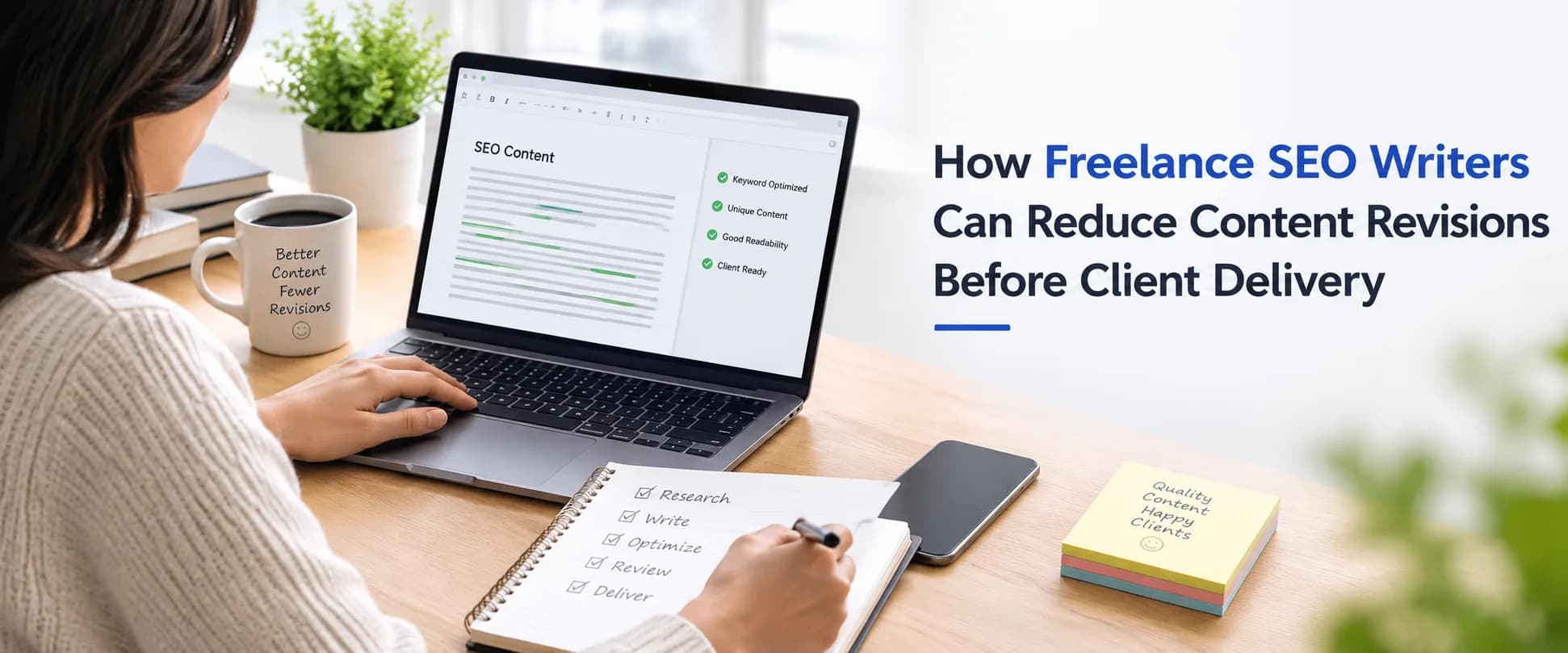
Freelance SEO writers often spend more time revising articles than writing the first draft. Client feedback about keyword placement, grammar, readability, missing information, and formatting can delay delivery and reduce project profitability.
The solution is not simply to write faster. It is to establish a repeatable content review process that catches common issues before the client sees the draft.
By combining SEO best practices, editorial checks, and the right writing tools, freelancers can improve content quality, reduce unnecessary revisions, and build stronger client relationships.
Why Do SEO Content Writers Receive Too Many Revisions?
Most content revisions happen because the delivered article does not fully match the client's expectations or content brief.
Common reasons include:
Missing search intent: The article does not answer the questions users are searching for.
Keyword issues: Primary and secondary keywords are missing, overused, or placed unnaturally.
Writing problems: Grammar mistakes, repetitive phrases, and long sentences make content difficult to read.
Insufficient research: Important facts, examples, or supporting information are missing.
Formatting inconsistencies: Headings, lists, links, and meta information do not follow the brief.
Unclear expectations: The writer and client have different ideas about tone, structure, or deliverables.
A consistent quality assurance process helps identify these problems before submission.
1. Understand the Content Brief Before Writing
Before starting an article, review the target audience, primary keyword, search intent, article length, tone of voice, competitor references, and required internal links.
For example, a blog targeting “best project management software for small businesses” should help readers compare solutions and make a decision. A general article explaining project management will not satisfy the same intent.
Create a checklist from the brief and use it throughout the writing process. If the client has not specified an important requirement, ask for clarification rather than making assumptions.
2. Optimize the Draft for SEO Before Delivery
SEO content should help readers first while making the topic and page structure clear to search engines.
Before submitting an article, check the following:
Include the primary keyword naturally in the title, introduction, and relevant headings.
Use related terms and supporting subtopics where they improve coverage.
Organize the article with descriptive H2 and H3 headings.
Write a useful meta title and meta description.
Add relevant internal links and descriptive anchor text.
Create a short, readable URL slug.
Answer the reader's main question without unnecessary introductions.
Avoid forcing keywords into every paragraph. Keyword frequency alone does not determine content quality or rankings. Prioritize relevance, helpful information, and natural language.
3. Review Content for Grammar, Readability, and Repetition
Even a well-researched article can require revisions if it contains awkward sentences, unnecessary words, or repetitive expressions.
Read the draft from the reader's perspective. Look for long sentences, unclear explanations, repeated ideas, inconsistent terminology, and paragraphs that do not contribute to the topic.
A grammar checker can help identify potential language issues, while a word counter and word frequency analyzer can help you review length and repeated terms.
CorrectifyAI offers tools that can support parts of this process, including a Word Counter, Word Frequency Analyzer, and writing-quality features. Use these tools alongside manual editing rather than treating automated suggestions as final decisions.
4. Check Originality and AI-Assisted Content Carefully
Freelancers may use AI to brainstorm ideas, create outlines, or develop initial drafts. However, every draft still requires human review for accuracy, originality, relevance, and brand consistency.
A Free Plagiarism Checker can help identify text similarities that may need investigation. Review flagged passages, verify quotations and citations, and rewrite material where necessary. A similarity result is not, by itself, proof of plagiarism.
A Free AI Checker Tool Online may provide an additional signal about whether text resembles AI-generated writing. However, AI detectors can produce false positives and false negatives, so their results should not be treated as definitive proof of authorship.
An AI Humanizer tool may help refine awkward or overly generic wording, depending on its capabilities. Always review the output to preserve the intended meaning, factual accuracy, brand voice, and original insights. Do not use these tools to disguise copied work or misrepresent authorship.
The goal is to deliver useful, trustworthy content—not simply to achieve a particular detector score.
5. Apply SEO, AEO, and GEO Principles
Modern content should be useful to readers across traditional search engines, answer engines, and generative AI experiences.
SEO (Search Engine Optimization): Make the article relevant to its target search query. Use clear headings, helpful content, descriptive metadata, and appropriate internal links.
AEO (Answer Engine Optimization): Answer important questions directly. Add concise explanations, relevant FAQs, definitions, and step-by-step instructions where appropriate. This makes information easier to understand and extract.
GEO (Generative Engine Optimization): Create well-supported content that AI-powered search experiences can interpret and reference. Use specific explanations, credible sources, original examples, and consistent terminology. No format guarantees that a page will be cited by an AI system.
These approaches work together. A clearly structured, accurate article can serve readers while improving its suitability for different search experiences.
6. Use a Final Pre-Delivery Checklist
Before sending the article to your client, review every deliverable against the original brief.
SEO checks
Search intent and audience are addressed.
Keywords are naturally incorporated.
Headings and metadata are complete.
Relevant internal links are included.
Content quality checks
Grammar, spelling, and punctuation are reviewed.
Repetitive wording and unnecessary sentences are removed.
Facts, statistics, and references are verified.
Originality concerns have been investigated.
The tone matches the client's brand.
Delivery checks
Word count meets the agreed requirement.
Formatting is consistent.
Required images, links, and additional deliverables are included.
The document follows the client's submission guidelines.
A final checklist makes the review process repeatable and reduces avoidable oversights.
7. Create a Repeatable Content Workflow
Instead of reviewing each article differently, use the same workflow for every project:
Brief review → Research → Outline → Draft → SEO optimization → Editing → Fact-checking → Final quality review → Client delivery.
Keep a record of recurring client feedback. If a client repeatedly requests shorter introductions or more examples, add those preferences to your writing checklist.
This turns past revisions into actionable improvements and helps you deliver more consistent work over time.
Frequently Asked Questions
How can freelance SEO writers reduce content revisions?
Freelance SEO writers can reduce revisions by following the content brief, matching search intent, optimizing on-page SEO, proofreading carefully, verifying facts, and using a consistent pre-delivery checklist.
Which tools can help SEO writers review content?
Word counters, word frequency analyzers, grammar checkers, plagiarism checkers, and AI content checkers can support different review tasks. Writers should combine automated checks with editorial judgment and fact verification.
Does passing an AI checker guarantee content quality?
No. AI checkers can make mistakes, and a favorable result does not guarantee accuracy, originality, readability, or SEO performance. Always review content manually.
How do SEO, AEO, and GEO differ?
SEO focuses on visibility in search engines, AEO focuses on providing clear answers to user questions, and GEO focuses on making information useful and understandable in generative AI search experiences.
Conclusion
Reducing client revisions starts with a better process, not simply faster writing. When freelance SEO writers understand the brief, optimize for search intent, review grammar and originality, apply SEO, AEO, and GEO principles, and complete a final checklist, they can deliver more consistent work.
Use CorrectifyAI to support your content review workflow, identify potential writing issues, and prepare articles for a more confident client handoff. Combine its tools with careful research and human editing to deliver content that meets both client expectations and reader needs.