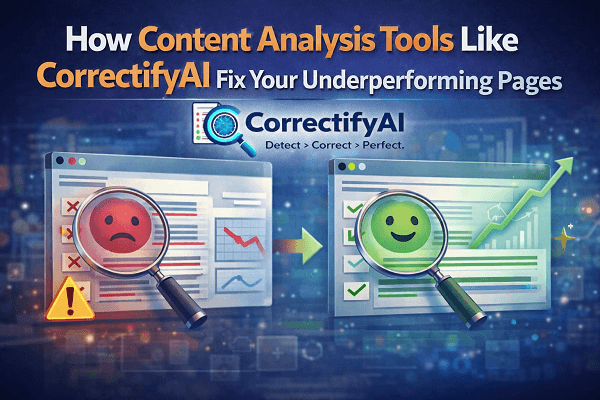
In 2026, Google’s algorithms prioritize helpful, comprehensive, and user-focused content more than ever. Yet many websites still struggle with underperforming pages - those blog posts, landing pages, or service pages that get indexed but barely show up in search results, drive minimal organic traffic, or see steady declines after core updates.
The good news? You don’t need to guess what’s wrong. Content analysis tools provide data-driven insights to diagnose issues fast and deliver clear fixes. Tools like CorrectifyAI’s free Content Analysis tool stand out by auditing any URL or pasted text against a target keyword, revealing problems in keyword usage, structure, readability, topical gaps, and overall on-page SEO.
In this guide, we’ll explore why pages underperform, how content analysis tools uncover hidden issues, and exactly how using a tool like CorrectifyAI can revive your rankings and traffic.
Why Your Pages Are Underperforming in 2026
Before fixes, understand the culprits. Common reasons pages fail to rank or lose visibility include:
Poor search intent alignment - Content doesn’t fully match what users want (informational, navigational, transactional).
Keyword issues - Missing primary keywords, unnatural placement, or over-optimization that feels forced.
Thin or outdated content - Shallow coverage, missing depth, or facts that no longer hold up post-updates.
Topical gaps - Failing to cover related subtopics competitors dominate, weakening topical authority.
Readability and structure problems - Long walls of text, poor headings, short paragraphs, or complex sentences that hurt user experience and dwell time.
On-page SEO weaknesses - Suboptimal title tags, meta descriptions, internal linking, image alt text, or schema markup.
Post-update penalties - Google’s helpful content and core updates devalue low-E-E-A-T (Experience, Expertise, Authoritativeness, Trustworthiness) pages.
Manual audits take hours per page. SEO content audit tools automate this, scanning instantly and prioritizing fixes that deliver the biggest impact.
How Content Analysis Tools Diagnose and Fix Underperforming Pages
Modern content optimization tools go beyond basic keyword density checks. They evaluate content holistically against top-ranking pages and current SEO best practices.
Here’s what a strong tool like CorrectifyAI analyzes:
Keyword Usage & Optimization Checks if your target keyword appears naturally in the title, intro, headings, and body. It flags under- or over-usage, suggests semantic variations, and ensures alignment with search intent.
Content Structure Reviews heading hierarchy (H1-H3), paragraph length, bullet points, and logical flow. Good structure helps Google understand your content and improves scannability for users.
Readability Assesses sentence complexity, passive voice, and overall ease of reading. High readability boosts engagement metrics like time on page — key ranking signals in 2026.
Topical Gaps & Depth Identifies missing subtopics or areas where competitors provide more comprehensive coverage. Filling these gaps strengthens topical authority and helps you compete for broader queries.
On-Page SEO Elements Highlights opportunities in meta tags, internal/external links, image optimization, and more to make pages more crawlable and appealing.
CorrectifyAI makes this effortless: Paste your content + target keyword (or enter a URL), select country/device, and get instant recommendations. No sign-up barriers for basic use, and it never alters your original text.
Step-by-Step: Using CorrectifyAI to Revive an Underperforming Page
Let’s walk through a real-world example.
Identify the Problem Page Use Google Search Console or Analytics to spot pages with declining impressions, clicks, or rankings. Focus on high-potential ones (decent backlinks, relevant keywords in positions 5–30).
Run the Analysis Go to https://correctifyai.com/content-analysis.
Option A: Enter the live URL.
Option B: Paste the content + primary target keyword. Hit analyze.
Review Key Insights The tool flags:
Low keyword presence in key areas.
Missing related terms (topical gaps).
Readability score needing improvement (e.g., too many complex sentences).
Structural issues like lack of subheadings or short content sections.
Implement Fixes
Add target keyword naturally to H1/intro.
Expand sections to cover identified gaps (add examples, stats, FAQs).
Break up text with headings, bullets, and shorter paragraphs.
Improve internal linking to related pages.
Re-Optimize & Monitor Update the page, resubmit via Search Console, and track performance over 4–8 weeks. Many users see 20–50% traffic lifts on optimized pages.
Real Benefits: Traffic & Ranking Recovery
Content analysis isn’t theory - it delivers measurable wins:
Faster recovery from core updates by addressing E-E-A-T and helpfulness gaps.
Higher rankings for target keywords through better optimization.
More organic traffic - often 2–5× on revived pages.
Better user experience leading to lower bounce rates and higher conversions.
Time savings - Audit in minutes instead of hours.
Compared to manual checks or expensive enterprise tools, CorrectifyAI offers a fast, accessible starting point - free for core features, with premium upgrades for deeper insights.
Final Thoughts: Stop Guessing, Start Analyzing
If your pages are indexed but not ranking, the issue is rarely luck. It’s usually fixable problems in content quality, optimization, or depth.
Content analysis tools like CorrectifyAI cut through the noise, giving you precise, actionable recommendations to transform underperforming pages into traffic drivers.
Ready to diagnose your content? Head to the CorrectifyAI Content Analysis tool, run a quick audit on your weakest page, and apply the suggestions today. Thank you for your rankings and organic traffic rankings.