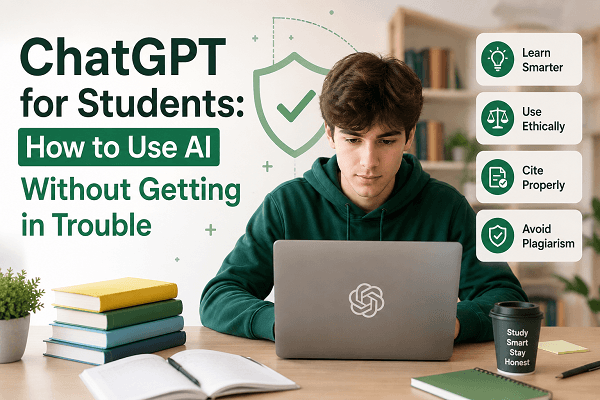
ChatGPT has quickly become a useful study companion for students. It can help explain difficult concepts, brainstorm ideas, improve writing, summarize information, and create study questions. But using AI for academic work also comes with an important responsibility: understanding when AI assistance is allowed and when it crosses the line into academic misconduct.
The rules are different from one school, college, university, or instructor to another. Some institutions allow limited AI assistance, while others may require students to disclose how they used AI. Harvard, for example, advises students to follow the specific policies established by their school or course.
So, how can students use ChatGPT productively without putting their academic work at risk?
Can Students Use ChatGPT for Schoolwork?
Yes, but how you use it matters.
Using ChatGPT as a learning or brainstorming assistant can be very different from submitting AI-generated work as your own. Some university guidance recommends using AI to support learning rather than avoiding the work required to complete an assignment yourself.
Before using ChatGPT for an assignment, check:
Your instructor's AI policy
Your university's academic integrity guidelines
Whether AI assistance must be disclosed
Which types of AI use are permitted
Whether submitting AI-generated text is prohibited
When in doubt, ask your instructor before submitting the assignment.
7 Responsible Ways Students Can Use ChatGPT
1. Use ChatGPT to Understand Difficult Concepts
One of the safest and most useful applications is asking ChatGPT to explain something you don't understand.
For example, instead of asking:
"Write my biology assignment."
Ask:
"Explain photosynthesis in simple terms and give me an example."
You remain responsible for learning the concept, while AI acts as a supplementary learning resource.
2. Brainstorm Ideas Before Writing
Having trouble deciding what to write about? ChatGPT can help generate potential topics, questions, or perspectives.
For example:
Prompt:
"Give me five possible arguments for an essay about the effects of social media on college students."
You can then research the ideas yourself and develop your own argument.
3. Create Study Questions
ChatGPT can turn your notes into practice questions, quizzes, or flashcards.
For example:
"Create 15 multiple-choice questions based only on these study notes."
This can help you identify knowledge gaps before an exam.
4. Use AI for Writing Feedback
Instead of asking ChatGPT to write an entire essay, you can use it as an editing assistant.
You might ask:
"Check this paragraph for grammar, clarity, and sentence structure. Explain what I should improve."
This approach keeps the ideas and original writing yours while helping you identify weaknesses.
5. Verify Every Important Fact
One of the biggest risks of using generative AI is that it can produce incorrect information or citations that appear convincing.
Never assume that an AI-generated answer is automatically accurate.
Check important facts against reliable sources, especially when writing research papers, essays, or academic reports. Recent examples of AI-assisted reports containing citation and factual errors show why verification remains essential.
6. Keep Your Drafts and Research
Save your notes, outlines, drafts, research sources, and revision history.
This gives you a record of how your assignment developed and can help demonstrate your own work if questions arise about authorship.
7. Follow Your University's AI Policy
There is no universal rule saying that every student can or cannot use ChatGPT.
Policies can vary significantly between institutions and even between individual courses. Your instructor's requirements should always take priority.
What About an AI Content Detector?
Students often worry that their professors will use an AI content detector to determine whether an assignment was written with AI.
AI detection is complicated. Recent research and reporting have highlighted concerns about false positives and the limitations of using detection scores as standalone evidence of academic misconduct. A 2026 study, for example, found significant problems when AI detectors were used to distinguish AI-assisted writing from human writing.
This means students should not treat an AI detector as an absolute test of whether writing is "safe" or "unsafe."
Instead, focus on producing authentic work, following your school's AI policy, and being transparent when disclosure is required.
Should Students Use an AI Content Checker Tool?
An AI content checker tool can be useful as an awareness tool when reviewing writing, but students should understand its limitations.
You can use an AI content checker to see whether your writing contains characteristics that automated systems may associate with AI-generated text. However, a detector result does not automatically prove who wrote a piece of content.
If you're concerned about your assignment, a better approach is to:
Review your university's AI policy.
Keep your original drafts and notes.
Make sure your arguments reflect your own understanding.
Verify facts and citations.
Disclose AI assistance when required.
Ask your instructor when the policy is unclear.
Tools such as CorrectifyAI can support students during the writing and review process, but the goal should be improving the quality and authenticity of your work - not finding ways to bypass academic rules.
What Should Students Never Ask ChatGPT to Do?
Students should be especially careful about using AI to:
Write an entire assignment for submission
Complete an exam or quiz when AI is prohibited
Generate fake citations or references
Fabricate research findings
Copy AI-generated answers without reviewing them
Misrepresent AI-generated work as entirely their own
Circumvent an instructor's explicit AI restrictions
The key question is simple: Is AI helping me learn, or is AI doing the academic work for me?
If AI replaces the work you're supposed to demonstrate yourself, you may be crossing an academic integrity boundary.
How to Use ChatGPT Without Getting in Trouble
A simple rule is to treat ChatGPT like a study assistant - not a replacement for your own thinking.
Use it to learn, brainstorm, practice, organize, and improve, while making sure the final work reflects your own understanding and follows your institution's rules.
Also remember that AI detection technology is not perfect. Recent research has documented false positives and limitations in AI detection, which is another reason students should maintain evidence of their writing process rather than relying on detector scores alone.
Frequently Asked Questions
Can I use ChatGPT for my college assignments?
It depends on your instructor and institution. Always check the applicable AI policy before using it for assessed work.
Can professors tell if I used ChatGPT?
AI detection tools may identify characteristics associated with AI-generated writing, but they are not perfectly reliable and should not automatically be treated as definitive proof of authorship.
Should I use an AI content checker before submitting an essay?
An AI content checker can provide additional information about your writing, but it should not replace following your university's AI policy or maintaining your own drafts and research.
Is using ChatGPT to check grammar cheating?
Not necessarily. It depends on your course policy and the extent of AI assistance allowed. If your instructor prohibits AI tools, even editing assistance may not be permitted.
What is the safest way to use ChatGPT as a student?
Use it for learning, brainstorming, explanations, practice, and permitted editing support. Keep your work authentic, verify AI-generated information, and follow your instructor's disclosure requirements.
Final Takeaway
ChatGPT can be a powerful tool for students when it is used responsibly. The goal shouldn't be to hide AI use or "beat" an AI detector. Instead, use AI to strengthen your understanding while keeping your own ideas, research, judgment, and learning at the center of the assignment.
When you understand your school's rules, verify AI-generated information, maintain your writing process, and use AI as a learning assistant rather than a substitute for your work, you can benefit from AI while protecting your academic integrity.