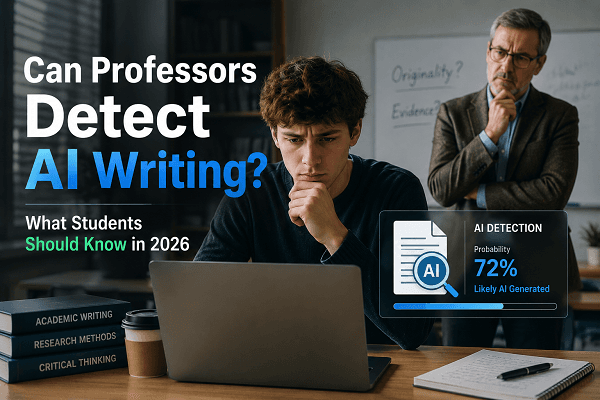
Artificial Intelligence has changed the way students research, write, and edit assignments. Tools like ChatGPT and other AI writing assistants can generate essays, summaries, reports, and even research ideas within seconds. While these tools save time, they also raise an important question among students:
Can professors detect AI writing?
The short answer is yes - but not always with complete certainty.
In 2026, universities and colleges are becoming more aware of AI-generated content. Many educational institutions use AI detection software alongside traditional plagiarism checkers. However, AI detection tools are not perfect, and professors often rely on multiple methods to determine whether an assignment reflects a student's own understanding.
In this guide, you'll learn how professors identify AI-written assignments, the limitations of AI detectors, and practical ways to use AI responsibly while maintaining academic integrity.
Why Are Universities Concerned About AI Writing?
Educational institutions encourage students to develop critical thinking, research, and writing skills. When an assignment is generated entirely by AI without meaningful student input, it may not accurately reflect a student's knowledge.
Because of this, many schools have introduced AI usage policies that encourage transparency and responsible use rather than banning AI altogether.
Students are now expected to use AI as a learning assistant - not as a replacement for their own work.
How Do Professors Detect AI Writing?
Professors rarely depend on a single tool. Instead, they combine technology with their own academic experience.
1. AI Detection Software
Many institutions use AI detection platforms that analyze writing patterns and estimate whether content appears to be AI-generated.
These tools typically examine:
Sentence predictability
Writing consistency
Vocabulary patterns
Repetitive structures
Overall writing style
However, these tools provide probabilities rather than definitive proof.
2. Comparing Your Previous Assignments
One of the most effective ways professors identify AI-generated work is by comparing it with your earlier submissions.
If your previous assignments contained simple language but your latest paper suddenly becomes highly polished with an advanced vocabulary, it may raise questions.
Consistency in writing style matters.
3. Looking for Generic or Surface-Level Content
AI often produces content that sounds professional but lacks originality or critical analysis.
Professors may notice:
Generic introductions
Repetitive ideas
Limited real-world examples
Weak arguments
Lack of personal insights
Assignments that fail to demonstrate independent thinking are more likely to be reviewed carefully.
4. Checking Sources and Citations
AI-generated essays occasionally include incorrect or fabricated references.
Professors often verify:
Academic journal citations
Book references
Publication dates
DOI numbers
Website sources
Incorrect citations can quickly reduce credibility.
5. Oral Discussions and Viva Questions
Some instructors ask students to explain their assignments during presentations or viva sessions.
If a student cannot explain key arguments, research findings, or conclusions, it may indicate they relied heavily on AI without understanding the content.
Are AI Detection Tools Always Accurate?
No.
AI detectors have improved significantly, but they are not 100% accurate.
They can sometimes:
Flag human-written content as AI-generated.
Miss AI-generated text that has been heavily edited.
Produce different results across different platforms.
For this reason, most universities treat AI detection reports as supporting evidence rather than final proof.
Human judgment remains essential.
Is Using AI for Assignments Allowed?
The answer depends on your school's academic policy.
Many universities allow AI for tasks such as:
Brainstorming ideas
Creating outlines
Improving grammar
Simplifying complex concepts
Checking spelling and punctuation
However, submitting fully AI-generated assignments without proper editing or disclosure may violate academic integrity guidelines.
Always review your institution's AI policy before using AI tools for coursework.
How to Use AI Responsibly
AI can be a valuable learning assistant when used ethically.
Here are some best practices:
Research First
Understand the topic before asking AI for help. Independent research helps you evaluate whether AI-generated information is accurate.
Write Your Own First Draft
Create your own outline and key arguments. Use AI to improve clarity rather than generate the entire assignment.
Add Personal Analysis
Include your own interpretation, examples, research findings, and critical thinking.
Original insights make your work stronger and more authentic.
Verify Every Fact
Always double-check statistics, quotations, and references generated by AI.
Never assume AI is always correct.
Edit Carefully
Review every paragraph to ensure it matches your own writing style and course requirements.
Common Mistakes Students Make When Using AI
Avoid these mistakes:
Copying AI responses without editing
Using fake citations
Ignoring assignment instructions
Not checking grammar and formatting
Depending entirely on AI for research
Submitting content you cannot explain
These mistakes increase the likelihood of academic concerns.
Improve Your Writing Before Submission
Even if you write your own assignment, proofreading is essential.
Before submitting your work:
Correct grammar mistakes
Remove unnecessary spaces
Fix formatting issues
Improve sentence clarity
Check punctuation
Review paragraph structure
Using reliable proofreading and text-cleaning tools can help ensure your assignment looks polished and professional.
Platforms like CorrectifyAI offer free writing utilities that help students clean formatting, improve readability, and prepare assignments before submission. While these tools enhance writing quality, they should complement - not replace - your own ideas and critical thinking.
Tips to Create Authentic Assignments
Follow these practical strategies:
Read multiple academic sources.
Take your own notes.
Use real examples.
Include critical analysis.
Cite reliable references.
Proofread before submitting.
Maintain your natural writing style.
Use AI only as a learning assistant.
These habits help produce assignments that genuinely reflect your knowledge.
Final Thoughts
AI has become an important part of modern education, but it should be used responsibly. Professors are becoming more skilled at identifying assignments that rely too heavily on AI, and detection tools continue to evolve.
Rather than asking whether professors can detect AI writing, students should focus on producing original, thoughtful, and well-researched assignments. AI is most effective when it supports your learning process instead of replacing it.
By combining your own ideas with careful editing, proper citations, and thorough proofreading, you can submit assignments that are both authentic and academically sound. Tools like CorrectifyAI can help refine grammar, formatting, and readability, but your knowledge, analysis, and unique perspective remain the most valuable parts of your work.
Frequently Asked Questions
Can professors prove I used AI?
Not with absolute certainty in most cases. AI detection tools provide estimates, and professors typically combine software results with writing style analysis, source verification, and their own academic judgment.
Can AI detectors make mistakes?
Yes. They can incorrectly identify human-written content as AI-generated or fail to detect edited AI text.
Is AI writing considered plagiarism?
AI-generated content is different from traditional plagiarism. However, submitting AI-written work as entirely your own may violate your institution's academic integrity policy.
Should students avoid AI completely?
No. Many universities encourage responsible AI use for brainstorming, grammar improvement, and learning support while expecting students to create original work.