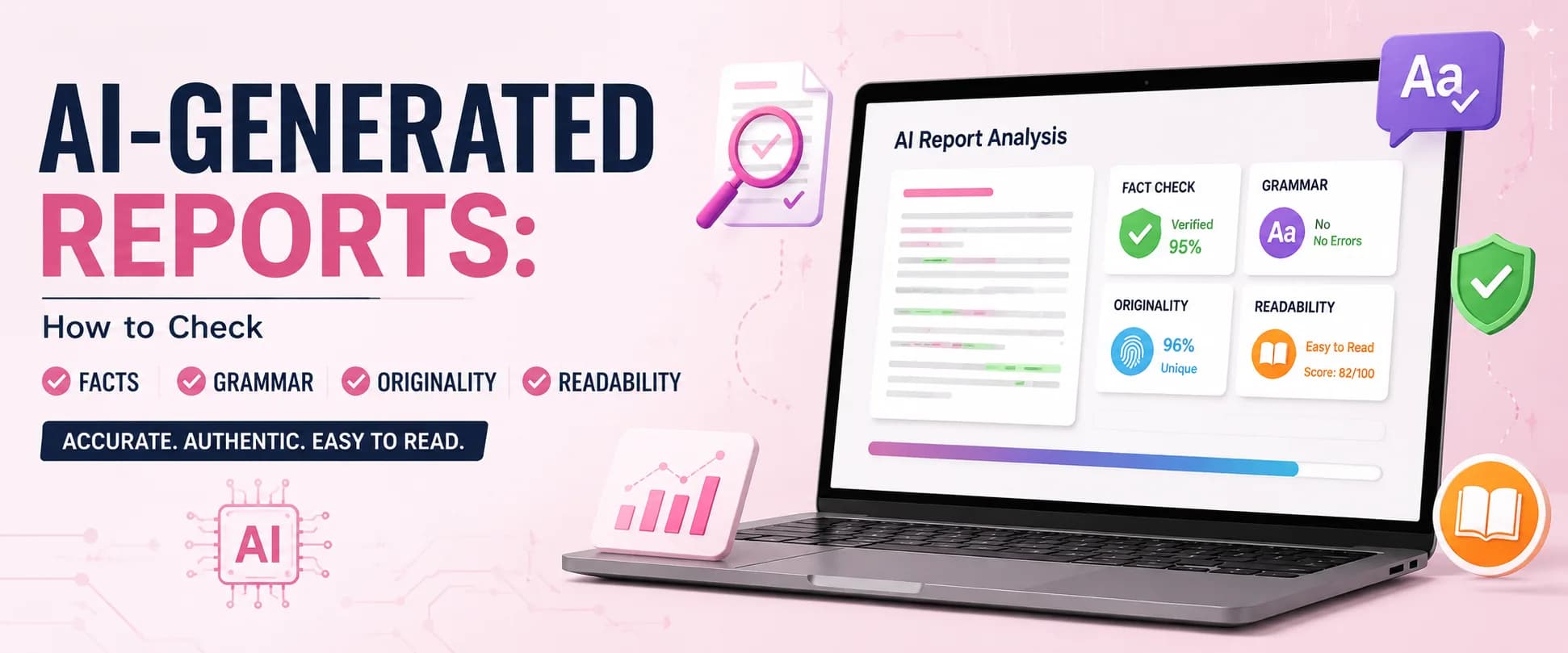
AI tools have made it easier than ever to create business reports, research summaries, market analyses, project updates, and other professional documents. In just a few minutes, AI can turn a large amount of information into a structured report.
But faster writing does not always mean better writing.
AI-generated reports can contain incorrect facts, outdated information, repetitive wording, grammatical mistakes, unclear sentences, or content that is too similar to existing sources. Before sharing an AI-generated report with a client, manager, customer, professor, or online audience, it is important to review its accuracy, originality, grammar, and readability.
A reliable content-checking workflow can help you turn an AI-generated draft into a clear, credible, and professional report.
Why Should You Check an AI-Generated Report?
AI-generated content can sound confident even when some information is inaccurate or incomplete. AI may also misunderstand context, use outdated information, or generate unsupported claims.
This can create problems for businesses, marketers, researchers, students, and content professionals.
Before publishing or submitting a report, check:
Facts: Are statistics, claims, dates, and statements accurate?
Originality: Is the content sufficiently original?
Grammar: Are spelling, punctuation, and sentence structures correct?
Readability: Can your target audience understand the report easily?
Clarity: Does the report communicate information without unnecessary complexity?
Checking these areas helps reduce errors and improves the overall quality of AI-assisted writing.
1. Fact-Check Every Important Claim
The first step is verifying the information contained in your report.
AI-generated reports may include statistics, names, dates, research findings, market figures, or other factual claims. Never assume that information is correct simply because it sounds authoritative.
Pay particular attention to:
Statistics and percentages
Research findings
Financial figures
Industry trends
Product specifications
Dates and historical information
Names and job titles
Citations and references
Medical, legal, or technical claims
For important information, compare the statement with reliable primary or authoritative sources.
An automated fact-checking tool can also help identify claims that require further verification. However, automated checking should support - not completely replace - human judgment.
2. Check the Report for Originality
AI-generated content may produce wording that resembles information already published online. Even when text is not intentionally copied, similarities can create originality concerns.
This is particularly important for:
Business reports
Academic assignments
Research papers
Website content
Marketing reports
Client deliverables
Industry analysis
Run the completed report through a plagiarism or originality checker before publication or submission.
A plagiarism check can help identify potentially similar passages so you can review and rewrite them where necessary.
Remember that originality is more than simply avoiding copied sentences. A strong report should also include your own analysis, interpretation, examples, and conclusions.
3. Use a Grammar Checker Tool
AI-generated writing can appear grammatically perfect, but mistakes can still occur. Long sentences, awkward phrasing, punctuation problems, inconsistent terminology, and incorrect word choices may reduce the professionalism of a report.
Using a Grammar checker tool can help identify common problems such as:
Spelling mistakes
Grammar errors
Punctuation issues
Subject-verb agreement
Sentence fragments
Awkward sentence construction
Repetitive wording
Inconsistent language
However, don't automatically accept every suggested correction. Review the recommendation and make sure it preserves the intended meaning and tone of your report.
For professional documents, grammar checking should be part of the editing process - not the final definition of quality.
4. Check Readability for Your Target Audience
A report can be factually accurate and grammatically correct but still be difficult to understand.
This is where a Readability checker can help.
Readability evaluates how easily readers can understand your content. It can help identify issues such as:
Very long sentences
Large paragraphs
Complex vocabulary
Excessive passive voice
Poor sentence flow
Dense sections
Unclear wording
For example, instead of writing:
“The implementation of artificial intelligence technologies facilitates the optimization of organizational processes across multiple operational departments.”
You could write:
“AI can help organizations improve processes across different departments.”
The second version communicates the same basic idea more directly.
The appropriate readability level depends on your audience. A technical research report may require more specialized terminology than a customer-facing business report. The goal is not always to make writing extremely simple; it is to make it appropriate and understandable for the intended reader.
5. Review the Report Structure
AI can generate well-formatted content, but the structure may not always match your purpose.
After checking individual sentences, review the report as a whole.
Ask:
Does the introduction clearly explain the purpose?
Are the main findings easy to locate?
Are headings descriptive?
Does each section support the main topic?
Are conclusions supported by the evidence?
Are there unnecessary sections or repeated ideas?
Is the information presented in a logical order?
Use headings, short paragraphs, bullet points, tables, and summaries where appropriate.
A well-structured report is easier for both people and search systems to understand.
6. Create a Simple AI Report Quality-Check Workflow
Instead of checking everything randomly, use a consistent process:
Step 1: Generate the initial AI-assisted draft.
Step 2: Fact-check important claims, statistics, and references.
Step 3: Check the report for plagiarism and content similarity.
Step 4: Run the document through a grammar checker.
Step 5: Use a readability checker to identify difficult sections.
Step 6: Review the report manually for accuracy, context, tone, and originality.
Step 7: Add your own insights, examples, analysis, and conclusions.
Step 8: Complete a final review before publishing or submitting.
This workflow helps separate AI's role in drafting from the human responsibility for quality and accuracy.
How CorrectifyAI Can Help
CorrectifyAI brings several content-quality checks into one workflow. Instead of reviewing an AI-generated report with completely separate tools, users can check important aspects of their writing in one place.
You can use the platform to support tasks such as AI-content detection, plagiarism checking, fact verification, grammar improvement, and readability analysis.
This makes the process useful for students, researchers, marketers, content writers, businesses, and other professionals working with AI-assisted content.
Frequently Asked Questions
Are AI-generated reports always accurate?
No. AI-generated reports can contain incorrect, outdated, incomplete, or unsupported information. Important claims should always be verified before the report is published or submitted.
How can I check an AI-generated report?
Start by checking facts and sources, then review originality, grammar, readability, structure, and overall context. A combination of automated tools and human review provides a stronger quality-control process.
Why is readability important in business reports?
Readability helps your audience understand key information quickly. Clear sentences, logical structure, appropriate terminology, and concise paragraphs can make complex reports easier to use.
Can a grammar checker improve an AI-generated report?
Yes. A grammar checker can identify spelling, punctuation, sentence structure, and other language issues. However, human review is still important for tone, context, accuracy, and meaning.
What should I check before publishing an AI-generated report?
At minimum, check accuracy, originality, grammar, readability, citations, structure, and audience suitability. Also review important claims manually before publication.
Final Thoughts
AI can significantly reduce the time required to create reports, but an AI-generated draft should not automatically be treated as a finished document.
A high-quality report needs more than fluent sentences. It should contain accurate information, original analysis, correct grammar, clear organization, and a readability level appropriate for its audience.
By combining fact checking, originality checks, a Grammar checker tool, and a Readability checker with human review, you can turn an AI-generated draft into a more reliable and professional report.
The goal is not simply to produce content faster. The goal is to produce content that readers can trust, understand, and act on.