Artificial Intelligence has completely transformed the way people create content. From blog posts and emails to product descriptions and social media captions, AI writing tools can generate thousands of words in just a few minutes.
But one question continues to dominate the SEO world:
Does Google prefer human-written content over AI-generated content?
Many website owners worry that publishing AI-generated articles will hurt their rankings, while others believe AI can completely replace human writers.
The truth lies somewhere in between.
In this guide, we'll explain what Google actually says about AI-generated content, how AI detection works, and why combining AI with human editing is the best strategy for long-term SEO success.
Does Google Penalize AI Content?
The short answer is No.
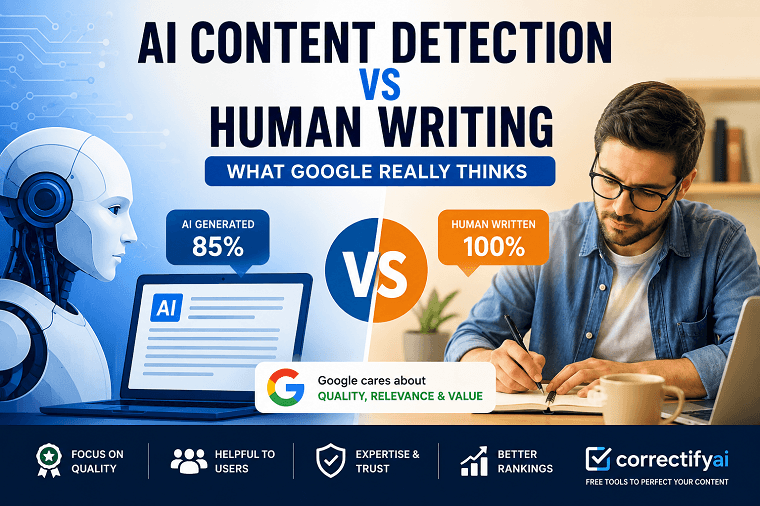
Google does not penalize content simply because it was created using AI.
Instead, Google focuses on one thing:
Is the content helpful, accurate, original, and valuable for users?
Whether your article is written by a human or generated with AI, Google's ranking systems evaluate its overall quality rather than the method used to create it.
If AI content provides useful information, answers user questions, and demonstrates expertise, it has the potential to rank just as well as human-written content.
However, low-quality AI content created only to manipulate search rankings may struggle to perform well.
What Makes Human Writing Different?
Human writers naturally add qualities that AI often struggles to replicate, such as:
Personal experience
Emotional storytelling
Industry expertise
Original opinions
Real-world examples
Creativity
Humor
Cultural understanding
These elements help create engaging content that builds trust with readers.
For example, a digital marketer sharing actual SEO case studies provides more value than an article that simply summarizes information already available online.
Where AI Writing Excels
AI has become an excellent assistant for content creators.
It can quickly generate:
Blog outlines
Product descriptions
Email drafts
Meta titles
Meta descriptions
FAQ sections
Social media captions
Technical documentation
Instead of replacing writers, AI significantly reduces the time needed to create first drafts.
Many professional content marketers now use AI to speed up research and brainstorming before refining the content manually.
AI Detection Tools: How Do They Work?
AI detection tools analyze writing patterns to estimate whether content was likely generated by artificial intelligence.
These tools evaluate factors like:
Sentence structure
Word predictability
Language patterns
Repetition
Burstiness
Perplexity
Writing consistency
However, no AI detector is 100% accurate.
Human-written content can sometimes be flagged as AI-generated, while heavily edited AI content may appear human-written.
Because of these limitations, AI detection scores should be treated as indicators rather than definitive proof.
What Google Really Cares About
Google rewards content that demonstrates genuine value.
High-quality content typically includes:
Original Information
Avoid copying or lightly rewriting existing articles.
Provide fresh insights, updated statistics, examples, or unique perspectives.
Helpful Answers
Address the user's search intent completely.
Answer common questions clearly and naturally.
Expertise
Show knowledge of your industry.
Support your claims with credible information whenever possible.
Readability
Use:
Short paragraphs
Clear headings
Bullet points
Simple language
Readers should be able to scan your article quickly.
User Experience
Fast-loading pages, mobile-friendly layouts, and easy navigation also contribute to overall content quality.
Why Pure AI Content Often Performs Poorly
Many AI-generated articles fail because they:
Repeat generic information
Lack personal experience
Miss important context
Include factual inaccuracies
Use repetitive wording
Sound robotic
Publishing hundreds of untouched AI articles rarely produces sustainable SEO results.
Human editing remains essential.
The Best SEO Strategy: AI + Human Editing
The most successful publishers don't choose between AI and humans.
They combine both.
Here's a practical workflow:
Step 1
Use AI to generate ideas and outlines.
Step 2
Expand the article with detailed explanations.
Step 3
Fact-check every important claim.
Step 4
Add personal expertise, examples, and original insights.
Step 5
Improve readability.
Step 6
Optimize the article for SEO.
This approach produces higher-quality content while saving valuable time.
Improve Your Content with CorrectifyAI Free Tools
At CorrectifyAI, we provide free writing and formatting tools that help content creators improve quality before publishing.
Some of our most useful tools include:
Word Counter
Character Counter
Text Cleaner
Case Converter
Word Frequency Analyzer
SEO Slug Generator
JSON Formatter
Base64 Encoder
LinkedIn Text Formatter
Mermaid Diagram Generator
Whether you're writing blog posts, documentation, or marketing copy, these free tools help improve readability, formatting, and SEO optimization.
For example:
Use the Word Counter to maintain your target article length.
Generate clean, SEO-friendly URLs with the SEO Slug Generator.
Remove hidden formatting using the Text Cleaner.
Analyze keyword usage with the Word Frequency Analyzer.
Check title length using the Character Counter.
These small improvements can make your content more professional and easier for both users and search engines to understand.
Tips for Creating SEO-Friendly AI Content
If you're using AI for content creation, follow these best practices:
Focus on Search Intent
Understand what users actually want before writing.
Add Original Value
Include personal insights, examples, screenshots, or case studies.
Avoid Keyword Stuffing
Use keywords naturally throughout the article.
Optimize Headings
Structure your content using H2 and H3 headings.
Edit Every Draft
Never publish AI-generated content without reviewing it.
Improve Readability
Break long paragraphs into shorter sections.
Use Internal Links
Link to relevant pages and free tools on your website whenever appropriate.
Common Myths About AI Content
Myth 1: Google Automatically Detects AI Content
False.
Google evaluates content quality rather than whether AI was used.
Myth 2: AI Content Cannot Rank
False.
Many high-ranking pages use AI-assisted writing combined with human editing.
Myth 3: AI Replaces Human Writers
False.
AI is a productivity tool, not a replacement for expertise and creativity.
Final Thoughts
The debate between AI content and human writing isn't about choosing one over the other.
The real advantage comes from combining AI's speed with human creativity, expertise, and editorial judgment.
Google rewards content that genuinely helps users, regardless of how the first draft was created.
If you focus on producing accurate, useful, and engaging content, AI can become a valuable part of your SEO strategy instead of a risk.
Before publishing your next article, improve its quality using free writing tools. From counting words and characters to generating SEO-friendly slugs and cleaning text formatting, CorrectifyAI helps you create content that's optimized for both readers and search engines.
By combining smart AI assistance with thoughtful human editing, you'll create content that earns trust, improves rankings, and delivers long-term SEO success.
Frequently Asked Questions
Is AI-generated content bad for SEO?
No. AI-generated content is not bad for SEO if it is accurate, original, helpful, and properly edited.
Can Google detect AI-written content?
Google focuses on content quality rather than whether AI was used to create it.
Should I edit AI-generated articles?
Yes. Human editing improves accuracy, readability, originality, and user experience.
What is the best way to use AI for content writing?
Use AI for research, outlines, and first drafts, then add human expertise, fact-checking, and SEO optimization before publishing.
Which CorrectifyAI tools can improve my content?
You can use the Word Counter, Character Counter, SEO Slug Generator, Text Cleaner, Word Frequency Analyzer, and other free tools from CorrectifyAI to improve content quality and readability.