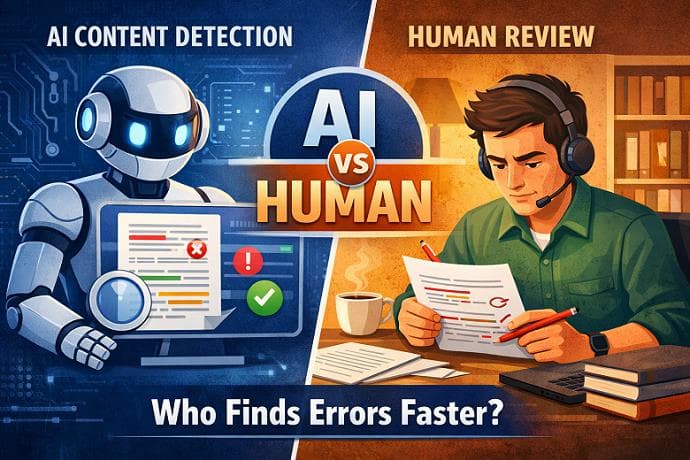
In the fast-paced world of content creation, accuracy is everything. Whether you're a marketer, publisher, or writer, spotting errors like grammatical mistakes, factual inaccuracies, or even AI-generated inconsistencies can make or break your work. But when it comes to AI content detection versus human judgment, who reigns supreme in speed? This article dives into the debate, exploring how tools like CorrectifyAI stack up against traditional human review processes. With keywords like AI content detection, human judgment, and error catching speed in mind, we'll uncover insights to help you optimize your workflow.
Understanding AI Content Detection
AI content detection refers to advanced algorithms designed to scan text for errors, plagiarism, and authenticity issues. These systems use machine learning to identify patterns that humans might overlook, such as subtle AI-generated phrasing or duplicated content from vast databases.
Modern AI tools excel in rapid analysis. For instance, they can process thousands of words in seconds, flagging potential problems with high precision. Key benefits include:
Speed: AI scans content almost instantaneously, ideal for high-volume tasks.
Consistency: Unlike humans, AI doesn't tire or get distracted, ensuring uniform checks every time.
Scalability: Perfect for teams handling large-scale content, where manual reviews would be impractical.
In 2026, with AI integration deeper than ever, platforms emphasizing AI content detection are transforming how we ensure quality. They not only detect errors but also suggest fixes, blending detection with enhancement.
The Strengths of Human Judgment in Error Detection
Human judgment brings a nuanced touch to error catching that AI can't fully replicate. Experienced editors and proofreaders rely on intuition, context, and creativity to spot issues like tonal inconsistencies or cultural nuances.
While slower than AI, human review shines in:
Contextual Understanding: Humans grasp sarcasm, idioms, or industry-specific jargon that AI might misinterpret.
Creative Problem-Solving: Beyond flagging errors, humans can rephrase content for better engagement.
Ethical Considerations: People can evaluate bias or sensitivity in ways algorithms are still learning.
However, human judgment has limitations in speed. A thorough manual review might take hours or days, especially for lengthy documents, making it less efficient for time-sensitive projects.
Speed Showdown: AI vs. Human in Catching Errors
When pitting AI content detection against human judgment, speed is where AI often pulls ahead. Studies show AI tools can detect errors up to 10 times faster than humans for routine checks like grammar and plagiarism. For example, an AI system might scan a 2,000-word article in under 10 seconds, while a human could need 20-30 minutes.
But is faster always better? In simple error detection—such as spotting duplicated phrases or basic factual errors - AI wins hands down. Tools powered by AI content detection algorithms process data at lightning speed, using vast datasets to cross-reference information.
On the flip side, complex errors requiring deep comprehension, like logical fallacies or narrative flow issues, favor human judgment. Here, the "error catching speed" tilts toward quality over quantity. A hybrid approach often yields the best results: AI for initial scans, followed by human oversight.
Consider real-world scenarios:
Content Marketing: AI quickly flags SEO issues, allowing humans to focus on strategy.
Publishing: Detecting AI-generated content before going live prevents reputational risks, with AI handling the bulk of the workload.
Accuracy and Reliability: Beyond Just Speed
Speed matters, but accuracy is crucial in the AI vs. human error catching debate. AI boasts impressive rates - often 99% for plagiarism and AI detection - but it can produce false positives, mistaking creative writing for generated text.
Human judgment, while slower, offers higher reliability in ambiguous cases. The key is balance: Use AI for rapid detection and humans for validation. This ensures errors are caught efficiently without sacrificing depth.
Pros and Cons: Choosing the Right Approach
Pros of AI Content Detection:
Lightning-fast error identification.
Cost-effective for large volumes.
Integrates seamlessly with tools like readability checkers.
Cons:
May lack nuance in subjective areas.
Dependent on training data quality.
Pros of Human Judgment:
Superior in context and creativity.
Builds trust through personalized reviews.
Cons:
Time-consuming and prone to fatigue.
Scalability challenges for growing teams.
For many, the solution lies in AI-augmented human workflows, where tools accelerate the process without replacing expertise.
Real-World Examples and Case Studies
In content agencies, AI content detection tools have reduced review times by 50%, allowing faster client approvals. Publishers using advanced detectors catch AI-generated errors pre-publication, maintaining integrity. Writers avoid accidental plagiarism through quick scans, blending AI speed with human finesse.
One standout example is how CorrectifyAI combines detection with humanizing features, enabling users to catch and correct errors swiftly while preserving natural tone.
Conclusion: The Future of Error Detection
In the battle of AI content detection vs human judgment, AI often catches errors faster, especially in high-volume scenarios. However, the most effective strategy merges both - leveraging AI's speed and human's insight for unbeatable results.
Ready to experience this firsthand? Sign up for CorrectifyAI today and see how it revolutionizes your content workflow. With its powerful AI content detection capabilities, you'll catch errors faster than ever, ensuring your work stands out in a crowded digital landscape.
Frequently Asked Questions:
Who catches errors faster: AI content detection tools or human editors?
AI content detection tools catch errors much faster, often scanning thousands of words in seconds. Tools like CorrectifyAI process large volumes instantly, making them ideal for high-volume content. Human judgment, while thorough, can take minutes to hours per document due to careful reading and contextual analysis.
Are AI content detectors more accurate than human judgment?
AI detectors, such as CorrectifyAI with its claimed 99% accuracy, excel at consistent detection of patterns like AI-generated text or plagiarism. However, they can produce false positives or miss nuanced issues. Human judgment often proves more reliable for complex errors involving context, tone, or creativity, though it's prone to fatigue.
Can AI tools fully replace human proofreaders for error catching?
No, AI cannot fully replace humans. AI handles speed and routine checks effectively, but human editors provide superior insight into cultural nuances, logical flow, and ethical considerations. The best approach is hybrid: use AI for initial scans and humans for final validation.
What are the limitations of AI in detecting content errors compared to humans?
AI may overlook sarcasm, idioms, or subtle biases and can flag human-written text incorrectly. Humans tire or miss repetitive errors but excel at understanding intent and improving engagement. Tools like CorrectifyAI minimize these gaps by combining detection with humanizing features.
How can I combine AI content detection and human judgment for the best results?
Start with an AI tool for quick error flagging and plagiarism checks, then apply human review for depth and refinements. This workflow maximizes speed while ensuring quality, saving time for creators, marketers, and publishers.