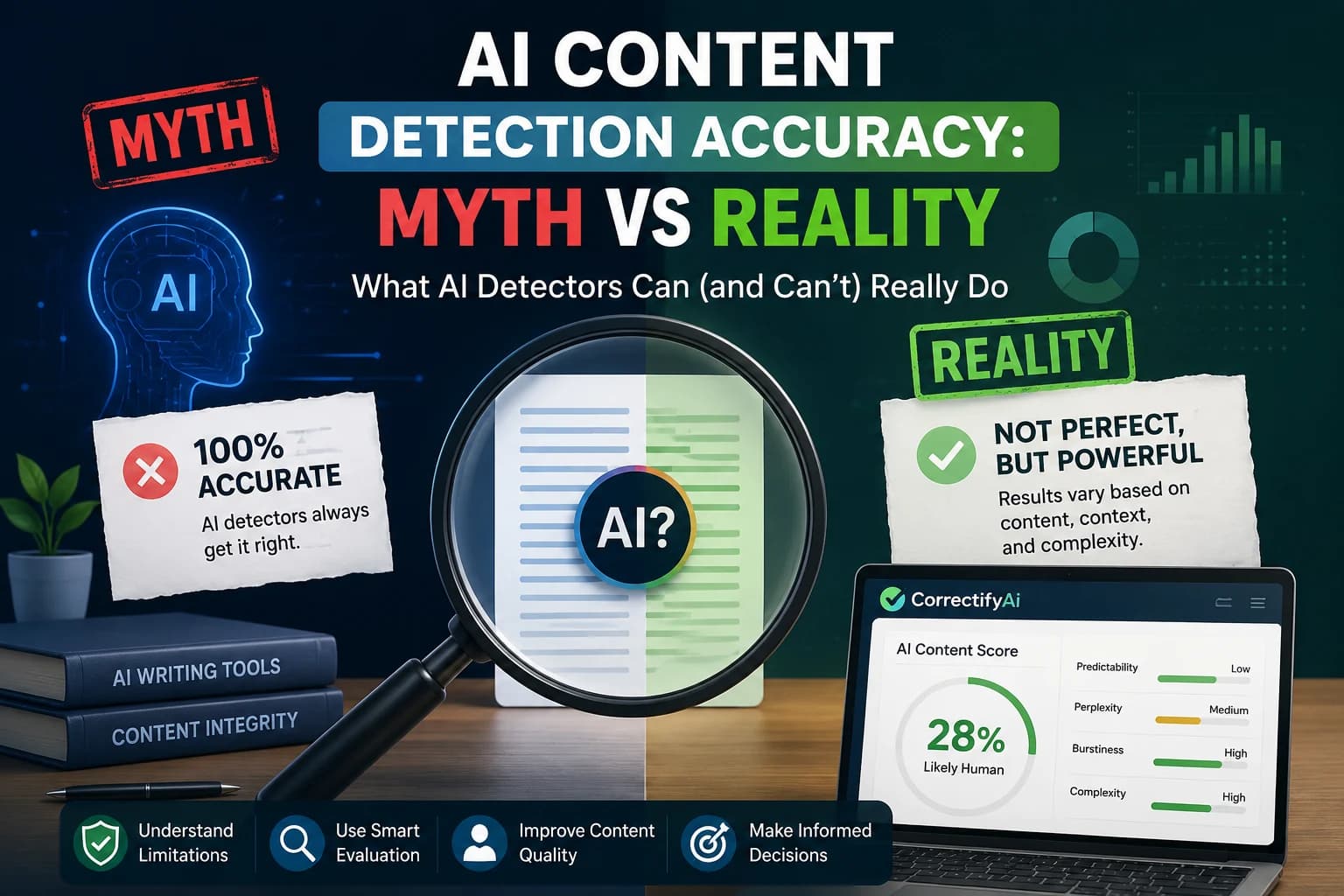
Artificial intelligence has transformed how people create content. Students use AI for assignments, marketers generate blog posts, businesses draft emails, and publishers produce articles faster than ever. As AI-generated writing becomes more common, AI content detectors have emerged as essential tools for verifying content authenticity.
But one important question remains:
How accurate are AI content detectors?
Some people believe AI detectors can identify machine-written text with 100% accuracy, while others claim they are completely unreliable. The truth lies somewhere between these extremes.
In this guide, we'll separate myths from reality, explain how AI content detection works, discuss its limitations, and share best practices for evaluating AI-generated content responsibly.
What Is AI Content Detection?
AI content detection is the process of analyzing text to estimate whether it was likely written by a human or generated by an artificial intelligence model.
Unlike plagiarism checkers, AI detectors do not compare text against existing web pages or databases. Instead, they evaluate writing characteristics such as:
Sentence structure
Vocabulary patterns
Predictability
Repetition
Writing consistency
Language complexity
Statistical probability
Modern AI detection tools combine machine learning with linguistic analysis to estimate the probability that content was AI-generated.
Myth #1: AI Detectors Are 100% Accurate
Reality: No AI detector is perfect.
One of the biggest misconceptions is that AI detection tools always produce correct results.
In reality, AI-generated writing has become increasingly human-like. Likewise, experienced human writers sometimes produce structured, predictable text that resembles AI writing.
As a result:
Human-written content may occasionally be flagged as AI-generated.
AI-generated content may sometimes appear human-written.
Detection results should always be viewed as probability estimates rather than absolute proof.
Myth #2: Every AI Tool Can Detect Every AI Model
Reality: Detection accuracy varies.
AI writing models evolve rapidly.
New versions of language models generate more natural language than previous generations, making detection increasingly challenging.
Detection accuracy depends on factors such as:
Model training data
Detection algorithms
Language support
Writing style
Content length
Updates to detection systems
No detector can guarantee identical performance across every AI writing platform.
Myth #3: Short Content Produces Reliable Results
Reality: Longer content generally improves accuracy.
AI detection relies on identifying writing patterns.
Very short text often doesn't contain enough information for meaningful analysis.
Examples include:
Product titles
Social media captions
Headlines
Email subject lines
Longer documents - typically 500 words or more - allow detectors to identify more consistent linguistic patterns, leading to better confidence levels.
Myth #4: AI Detection Equals Plagiarism Detection
Reality: They solve different problems.
Many users confuse AI detection with plagiarism checking.
AI Detection
Estimates whether AI generated the text
Examines writing patterns
Uses statistical language analysis
Plagiarism Detection
Finds copied or duplicated content
Compares against online sources
Protects originality
Both tools complement each other, but neither replaces the other.
Myth #5: Human Editing Makes AI Content Undetectable
Reality: Editing helps - but doesn't guarantee anything.
Simply replacing a few words isn't enough.
Modern AI detectors evaluate much more than vocabulary.
They also analyze:
Sentence rhythm
Paragraph transitions
Structural consistency
Word predictability
Overall writing flow
Careful editing that adds personal insights, examples, and original expertise improves content quality significantly, but no one should assume it guarantees a particular detection outcome.
How Accurate Are AI Content Detectors?
Most reputable AI detectors provide probability-based assessments rather than definitive yes-or-no answers.
Accuracy depends on multiple variables, including:
Writing quality
Topic complexity
Amount of text
Editing level
Language
Detector updates
Instead of relying on a single score, users should interpret results alongside human review and editorial judgment.
Best Practices for AI Content Detection
To achieve the most reliable assessment:
1. Analyze Complete Documents
Longer articles provide more meaningful language patterns.
2. Review Multiple Sections
If reviewing a long document, evaluate different sections instead of relying on one paragraph.
3. Combine Human Review
Editors should verify:
Accuracy
Tone
Context
Logic
Originality
Technology supports - not replaces - editorial expertise.
4. Improve Content Quality
Rather than trying to "beat" detection systems, focus on creating content that demonstrates genuine expertise, helpfulness, and originality.
Why Content Quality Matters More Than Detection Scores
Search engines increasingly prioritize content that demonstrates:
Experience
Expertise
Authority
Trustworthiness
Readers also value:
Clear explanations
Accurate information
Original insights
Practical examples
Helpful solutions
Whether content begins with AI assistance or not, human editing remains essential for delivering value.
How CorrectifyAi Supports Better Content Evaluation
A reliable workflow involves more than checking a single score. CorrectifyAi helps users evaluate writing by analyzing AI-generated patterns alongside other quality signals, making it easier to review content before publishing.
Writers, students, marketers, educators, and businesses can use CorrectifyAi as part of their editing process to identify areas that may benefit from additional human refinement, stronger originality, and improved readability.
Conclusion
AI content detection is a valuable technology, but it is not infallible. Understanding how these systems work - and where their limitations lie - helps users make better decisions about content quality and authenticity.
Rather than treating AI detection scores as absolute judgments, use them as one part of a broader editorial process. High-quality writing combines accurate information, original thinking, careful editing, and a reader-first approach. When supported by responsible AI tools and thoughtful human review, content is more likely to earn trust from both readers and search engines.
Frequently Asked Questions (FAQ)
Can AI content detectors guarantee 100% accuracy?
No. AI detectors provide probability-based assessments and should be combined with human evaluation.
Why do AI detectors sometimes flag human writing?
Predictable writing patterns, repetitive sentence structures, and limited context can sometimes resemble AI-generated text.
Does rewriting AI-generated content improve detection results?
Thoughtful editing that adds original ideas, expertise, and personal insights generally improves overall content quality, though no outcome can be guaranteed.
Is AI detection the same as plagiarism checking?
No. AI detection estimates whether text was generated by AI, while plagiarism detection identifies copied or duplicated material.
What is the best way to evaluate AI-generated content?
Use AI detection together with plagiarism checking, grammar review, readability analysis, fact-checking, and human editorial review.